What's different in Collibra when the latest user interface (beta) is enabled?
With release 2024.02, Collibra offers the latest user interface (UI) in beta testing. When the latest UI is enabled, multiple changes occur in Collibra.
Which features are available only in the latest UI?
- Admins can customize the theme of your Collibra environment, including logos and brand colors, via the new Customizations feature. This feature enables you to align your environment with your brand identity, for a more cohesive user experience. Note
- The Customizations feature is available in the General section on the Collibra settings page for admins.
- You can no longer apply styling customizations via CSS files.
- Admins can define the layout of the asset pages via the layout editor.
- They can customize the sections and characteristics on the asset page:
- Add characteristics and move characteristics through drag-and-drop.
- Expand and collapse characteristic sections to be full-width or half-width.
- Remove characteristics from the layout.
- Name, organize, and remove sections.
Note System content sections are not editable, because they are added by Collibra.
- Any changes made to the asset type layout are automatically saved through a new auto-saving feature.
- They can customize the sections and characteristics on the asset page:
-
You can register to participate in beta testing of Collibra AI Governance, via the Collibra Beta Platform. AI Governance offers a holistic end-to-end view of all your organization's AI projects.
-
You can use Edge Vaults to implement your management and rotation policies for your data source credentials and applicable connection properties used in your Edge site connections.
-
You can show or hide the Add to Data Set button in your environment for Column, Table, View, and Schema assets via a Data Marketplace setting.
-
An extra Catalog submenu, Data Source Registration, is available, to allow you to quickly navigate to the overview of registered data sources and to start the registration or integration process of a new data source.
-
For S3 integrations, you can provide a custom classifier name and a table level parameter in the S3 crawler configuration.
-
The History page always shows the most recent history entries, regardless of the start date.
-
Workflow tasks show an asterisk by default for any mandatory form field. This new feature makes existing workflows with tasks where you manually indicated mandatory fields by adding an asterisk show two asterisk signs.
Which features have been updated in the latest UI?
Asset pages
- We have improved the out-of-the-box asset pages:
- You can add and edit any content directly on the asset page.
Note You must have an Author role to edit on the asset page.
- The Add Characteristics button has been removed from the asset pages. This action is replaced with in-page editing. To add a characteristic, you must add it to the asset type first, and then drag it onto your asset layout page.
- On the asset tab page Summary, the Show empty values option allows you to show or hide fields that don’t have content.
- The new At a Glance sidebar on asset pages displays the last modified date, your colleagues that are assigned to the asset and their role, the average rating, the articulation score, and the asset tags.
The following fields are available in the At a Glance sidebar:- Articulation score
- Validation result and the Validate button
- Some fields and labels have been renamed:
- The Files tab is now the Attachments tab.
If there are attachments on an asset page, the count appears alongside the Attachments tab, for example, Attachments (2). - The Overview tab is now the Summary tab.
- The Details tab is now a Details section on the page.
- The Files tab is now the Attachments tab.
- When you click either the Diagrams tab or the Technical Lineage diagram, they both open on a new page.
- The References tab has been removed.
- Some available filters on the History page for an asset have been renamed:
- who is now User.
- from is now Start Date.
- to is now End Date.
It's also no longer possible to remove a filter from this page.
- When you add a relation, the Start Date and End Date fields are removed. This doesn’t affect the API.
- You can no longer switch the Complex Relations table to diagram view.
- The text editors have been updated:
- Text attributes in asset pages use the mini text editor, instead of the standard text editor.
- You can now apply several paragraph styles, including a code block, and you can also apply the code style to text.
- The Unlink option has been removed from the Link drop-down list in the toolbar and can now be accessed by clicking an individual link.
- When you select a checkbox, the associated text is shown with a strikethrough.
- Clear formatting may behave differently depending on the applied style.
- In the standard text editor:
- You can no longer upload an image via a URL path. You can drag an image to the text editor or upload the image from your computer.
- You can no longer add tables, also not via html code.
- You can add and edit any content directly on the asset page.
Dashboards
- The way you can work with dashboards is changed. Some of the changes are as follows:
- You can create a dashboard using the Create button.
- You can edit the name, description, and layout of a dashboard when you're creating or editing a dashboard.
- When creating or editing a dashboard, the widgets are shown in the left pane.
- When working on a widget, the option to configure or delete the widget can be found within
 .
.
- The Embedded Webpage widget is an out-of-the-box (packaged) widget.
- The To Do widget is renamed Tasks and Issues.
- The Text widget contains a dedicated editor for advanced HTML editing called HTML Editor. This editor also supports iframes.
- The Collibra Insights, Embedded Webpage, and Text widgets may be automatically resized when shown on a dashboard, depending on their content. You can, however, adjust their size when editing the dashboard by using the bi-directional arrow located at the bottom of those widgets.
Views
- The way you can work with tables and tiles is changed. For more information, go to Working with tables and Working with tiles.
- If you select the Trim text option in a table view and a visible cell contains multiple values, lines may be shown in the cell to indicate that the cell contains multiple values.
Search
- In the top navigation bar, the Search box is hidden by default. To see the Search box, in the top navigation bar, click
 .
. - The way you can use a search page is changed. For more information, go to Search page.
Assessments
Collibra Assessments is redesigned, making it easier than ever to evaluate the risks associated with how your organization uses or processes data:
- A refreshed landing page with new quick search fields, text-wrapping or trimming view options, access to the Template Gallery, and a redesigned prompt from which to conduct a new assessment.
- A refreshed template editor for creating custom assessment templates.
- A Pages section in the general properties of a template for defining the order of the pages.
- A new out-of-the-box assessment template for AI Governance customers.
- A new logic configuration wizard for creating and editing logic conditions.
Data Catalog
- Catalog asset pages have been updated:
- The Configuration tab is now available in the tab bar instead of the tab pane.
- Only the Description attribute can be updated.
The Description From Source, Source Tags, Type, profiling data, and so on are read-only fields. - Column asset page updates:
- The Data Profiling tab is replaced by the Descriptive Statistics section on the Summary tab.
- The Descriptive Statistics section contains:
- A Frequency or Distribution tab to show charts, if any are available for the data type.
The distribution chart can now open in a separate dialog box for interaction. - Sample Data.
- Column information grouped in: Statistics, Metadata, and, if available, Quantiles.
- A Frequency or Distribution tab to show charts, if any are available for the data type.
- The following profiling information is available in the At a Glance sidebar: Table Type, Data Source Type, Row Count, and Data Type.
Note The Data Type field in this sidebar refers to the Technical Data Type. In some cases, for structured data types, you can click the data type name to see the structure of the data in a dialog box.
- Data classification is available only in the At a Glance sidebar. Data class suggestions are marked with a suggestion icon.
- Table asset page updates:
- Column profiling information is always shown in the Columns section on the Summary tab.
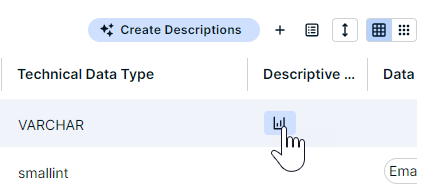
- In the Columns section in a Table asset, you can open a column chart by clicking the chart icon. The chart opens in a dialog box.
- Sample data is visible in:
Asset type Location of sample data Column Summary tab: Descriptive Statistics section Table Sample Data tab Data Set Sample Data tab - S3 integration changes:
- The procedure to create an S3 File System asset to integrate S3 via Jobserver has changed. You now manually create the S3 File System asset instead of using the Register System option.
- To create a crawler, you first need to click Edit Configuration and then Add Crawler, instead of clicking Create Crawler immediately.
- Data Stewardship changes:
- To add or update table values in the Data Stewardship module, double-click the field in a column.
- To remove a linked data attribute asset from a column via the Data Stewardship module, double-click the data attribute field, remove the value, and then click Save.
Edge
- Changes to Edge site connections:
- When you create a new connection, there is an additional step where you select your connection type before the Create a Connection wizard appears.
- Parameters are now called Properties.
- When creating an Edge site capability, there is an additional step where you select your capability template before the Add a Capability wizard appears.
Data Marketplace
- From the Data Marketplace landing page, you can directly open the Search and Discover pages.
- The Need help section is always visible on the search results page.
- Workflows created in Workflow Designer are compatible with Data Marketplace.
Workflows
- When opening an asset page, with the exception of following a task-related link to that asset page, the sidebar shows the At a glance information by default, instead of any active tasks.
- Workflow tasks with a Domain component that has proposed values filter the values based on your search.
- All workflow task buttons are grouped to the right, after the task content.
User Profile
- The user profile details are available in an About sidebar.
- The Global Roles tab is available on the Profile page. This tab shows the global roles assigned to the user.
- The Notification Settings combines both the content and product notification options.
Which features are no longer available in the latest UI?
- You can't customize Collibra-provided text or provide your own translations for Collibra-provided text. The available languages are: English, Spanish, French, and German. For more information, go to Edit or translate interface text.
-
Metrics aren't available:
- The Metrics tab is removed from Business Glossary, Data Helpdesk, Policy Manager, and Reference Data. For similar metrics, you can visit the Usage Analytics dashboard.
- The Metrics options are removed from the Catalog submenus, and the Metrics dashboard is removed from Data Stewardship.
-
On asset pages:
- The References tab is removed.
- When you add a relation, the Start Date and End Date fields are removed. This doesn’t affect the API.
- You can't switch the Complex Relations table to diagram view.
-
In the standard text editor:
- You can't upload an image via a URL path. You can, however, drag an image to the text editor or upload the image from your computer.
- You can't add tables, even using HTML code.
-
Data Marketplace
- On the Data Marketplace landing page, we no longer show an introduction section. This means the description you enter in the settings isn't used anywhere.
- On the Search page, the button to go back to the Search field isn't available.
-
Catalog experience: All Catalog asset pages have the same out-of-the-box layout. However, admins can tailor the asset pages.
-
Advanced data types aren't available.
-
You can't use version 1 of the import wizard.
-
When entering connection credentials for integrations such as ADLS and GCP, the option to provide the credentials already in encrypted form isn't available. You can, however, provide the credentials in plain text. The credentials will then be encrypted via Edge.
- The following deprecated features aren't supported in the latest UI:
- Business User Interface
- Privacy Dashboard
- Assessment-related assets and their workflows, including page layouts for CSA, DPIA, LIA, and PIA
- Disabling the task sidebar Console configuration option has no effect because all workflow tasks are shown in the sidebar.
- The Text widget on a dashboard doesn't support tables.
In Data Marketplace, you can't create new relation indexes. (known issue)
To create relation indexes, deactivate the latest UI.
After you have defined the indexes, you can enable the latest UI again and continue the configuration of Data Marketplace.
Which areas have not been moved to the latest UI yet?
Tip When you navigate to an area that has not been moved to the latest UI, the classic UI becomes visible. Once you navigate to an area that has been moved to the latest UI, you switch to the latest UI.
The following areas have not been moved yet:
- Most of the Collibra settings, except for Edge and Customization settings
- Console settings
- Diagrams on asset pages
To return to the asset page from a diagram, you need to click the Go to Asset button. - Technical Lineage tab on asset pages
- DQ standalone application
- Workflow Designer
What are the limitations and known issues?
For a list of all known issues, go to the Support Portal.
Where can you get help and make suggestions?
Use the public beta mechanisms to request help or make suggestions. For details, go to Public beta features.