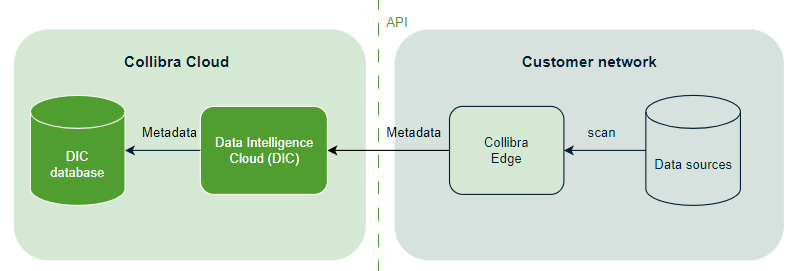
You can use Edge to register a data source and make metadata from the data source available in Collibra Platform while keeping the data in your infrastructure. The data flow is as follows:
 ) also has a dedicated integration workflow. For instructions on setting up the connection, configuring capabilities, and synchronizing schemas, go to Steps overview: Integrate Snowflake via Edge.
Prerequisites
- Verify the following settings and ensure:
- The Database registration via Edge setting is enabled to allow registering a data source via Edge.
- The Maximum number of concurrent Edge jobs setting meets your needs.
- The Maximum number of ingestion rules setting meets your needs.
-
- You have created a JDBC connection for your data source and have added the capabilities: Catalog JDBC ingestion capability.
If no JDBC connections and capabilities are configured, the following message appears in the Data Source Registration page: "No data available" and you can't continue registering the data source.
Steps
The following table shows the steps required to register a data source via Edge.
|
Step |
What? |
Description |
Results |
|---|---|---|---|
| 1 | Register a data source |
Creates the structure for the metadata in Collibra. |
For more information, go to the full overview. |
|
2 |
Allows you to define synchronization rules to indicate what you want to register. You can:
|
The information on the Configuration tab page of the Database asset is completed. |
|
| 3 |
Makes the metadata available in Collibra. |
Schema, Table, Column and Foreign Keys assets are created in the specified domain, and registration data becomes available. For more information, go to the full overview. |
|
| 4 | Optionally, profile the synchronized data. |
Data Profiling creates a summary of a data source in Data Catalog and determines the data type of columns in the data source. The summary mainly contains statistics and graphics to give the user an idea what the data is about. Data Profiling is available for registered JDBC data sources |
The Table and Column assets contain profiling information. |
Helpful resources
If you want to learn more and watch a recording, check out the Data source registration via Edge training on Collibra University.