or with Collibra AI
By creating a semantic layer you can later connect the physical layer with this semantic layer, making the information more meaningful and searchable. As a data steward, the Data models page in the Stewardship application allows you to create the semantic layer step by step and manage it.
Create a new data model
A Data Model asset in the semantic layer contains Data Entity and Data Attribute assets. You can group all in one data model or create various data models depending on your needs.
Prerequisites
- You have the required permissions.
- Ensure that your environment uses the latest user interface.
Steps
- Create a Logical Data Dictionary domain.
For information on how to create a domain, go to Create a domain.
We recommend storing each Data Model in a dedicated domain. -
On the main toolbar, click
 →
Stewardship.
→
Stewardship. - Go to Semantic layer → Data models.
If the New app experience setting is disabled, the menu item is called Semantic Models.
The Data Models page opens. This page shows all Data Model assets in your environment. - Click Create model.
- Complete the fields as follows.
Field
Description
Model name Enter the name of the data model. If Collibra AI is enabled, it uses this name when making suggestions.
Model description
Enter the description of the data model. If Collibra AI is enabled, it uses this description when making suggestions.
Owner
Select the user who needs to be assigned as the owner of the Data Model asset. Target domain Select the domain that you just created.
Collibra creates the data model in this domain.System Optionally, select the System asset that you want to link the data model to. Collibra links the Data Model and System assets through "is implemented in System" relation. - Click Create.
The Data Model asset is created and becomes visible. You can now add elements manually or, if enabled, use Collibra AI generated suggestions.
Manually create data entities and data attributes
You can add new data entities and data attributes to the Data Model yourself. If you do, the relations between the assets are automatically taken care of. New Data Entity assets are linked to the Data Model and new Data Attribute assets are linked to their corresponding Data Entity.
Prerequisites
- You have a global role with the Guided Stewardship global permission.
- You have created a Data Model asset.
- You have the required permissions.
- Ensure that your environment uses the latest user interface.
Steps
-
On the main toolbar, click
→
Stewardship.
- Go to Semantic layer → Data models.
If the New app experience setting is disabled, the menu item is called Semantic Models.
The Data Models page opens. This page shows all Data Model assets in your environment. - Select the model to which you want to add entities and data attributes.
- Add an entity.
- Click + Add.
The Add entity dialog box appears. - Enter a name and a description for the entity.
- Click Add.
The entity is saved as a Data Entity asset in the Data Model.
- Click + Add.
- Add an attribute.
- Select the data entity you created.
- In the Attributes pane, click +.
The Add Data Attribute dialog box appears. - Enter a name and a description for the attribute.
- Click Add.
The attribute is saved as a Data Attribute asset in the Data Model.
Create entities and data attributes with help of Collibra AI
Collibra AI can help you create the semantic layer by providing data entity and data attribute suggestions. These suggestions are based on physical data and, optionally, business assets found within your Glossary domains. Once the suggestions are available, you can review them to build your model.
- This feature isn't supported in Collibra Platform for Government or Collibra Platform Self-Hosted (CPSH) environments.
- For information about how we leverage AI in our products, including how we handle data that is used for training and input, go to the Collibra Trust Site.
- This feature consumes Collibra Units.
Steps overview
- Check the prerequisites.
- Start the generation of suggestions.
- Review the generated data entity suggestions.
- Review the generated data attribute suggestions.
Prerequisites
- The Semantic Model Generation setting has been enabled.
- You have added physical data assets to your Collibra environment, such as Schema, Table, and Column assets.
- Optionally, you have created business glossaries; these are business assets found within your Glossary domains.
- Optionally, you have created KPIs and measures within your Report Catalog domains.
- You have created a Data Model asset.
- You have the required permissions.
- Ensure that your environment uses the latest user interface.
Start the generation of suggestions
-
On the main toolbar, click
→
Stewardship.
- Go to Semantic layer → Data models.
If the New app experience setting is disabled, the menu item is called Semantic Models.
The Data Models page opens. This page shows all Data Model assets in your environment. - Select the data model to which you want to add data entities and data attributes.
The first time you open the model to generate data entities and data attributes, the Generate entities and attributes button is available. If you already have data entities with data attributes, the Extend model button is shown instead. - Click Generate entities and attributes or Extend model, respectively.
A dialog box appears showing a wizard. - Complete the wizard as follows:
- Select the input data through the Database and Schemas fields.
The input data is the data that you want Collibra AI to reference when generating suggestions.
You can select one database and up to 3 schemas in that database. In the next step, you are able to select specific tables from the selected schemas. - Click Next.
The Manage tables step appears showing all tables in the selected schemas. - Refine your data selection by selecting the tables to be analyzed from the schemas you previously specified.
- You can select up to 50 tables.
- To select all tables, navigate through each page in the table and select all.
- You can filter tables by Schema, Table name, and Status by hovering over the header and clicking the Search icon
 .
. - Tables with the Missing from Source status aren't shown.
- Click Next.
The Select business data step appears. - Optionally, in the Business terms field, select one or more domains.
By providing business assets, Collibra AI has an idea of the conceptual layer and is able to provide better suggestions.- You can select from all domains that can contain the Business Term asset type. For information, go to Asset type assignments.
- You can select up to 10 domains.
- Collibra AI can process a maximum of 1,000 business terms, across all selected domains.
- Optionally, in the Measures field, select one or more domains.
By providing measure or KPI assets, Collibra AI can map suggested data attributes to these assets.- You can select from all domains that can contain the Measure or KPI asset type. For information, go to Asset type assignments.
- You can select up to 10 domains.
- Collibra AI can process a maximum of 1,000 KPIs and measures, across all selected domains.
- Click Next.
- If the Add preference step appears, define if you want Collibra AI to update any existing non-approved suggestions, and click Next.
This step appears only if you are extending the model.
Switch the Allow editing of existing entity & attribute suggestions on if you want to allow Collibra AI to update non-approved suggestions.
Approved entities and attributes will not get updated. - In the Summary step, the completeness of the metadata for the selected tables is shown through the following metrics:
- % of Table assets that have a description or description from source.
- % of Column assets that have a description or description from source.
- % of Column assets that have an assigned data class.
- % of Business Terms assets that have a definition.
- % of Measure (KPI) assets that have a definition.
- % of Measure (KPI) assets that have a calculation rule.
Higher percentages indicate more complete and accurate metadata, which increases the likelihood of more relevant and precise suggested entities and attributes. Fetching the metrics can take some time. It doesn't prevent you from proceeding. You can generate a model without a full summary.
- Select the input data through the Database and Schemas fields.
- Click Generate.
The Semantic Model Generation Collibra AI agent starts the generation process. It checks the metadata of the selected tables and creates suggestions for entities and attributes based on the analysis and provided information.
The agent automatically detects the language used based on Data Model name and description, and generates suggestions in that language. If the language can't be detected, English is used by default.
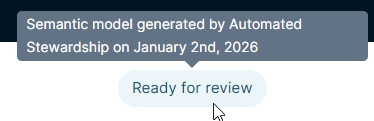
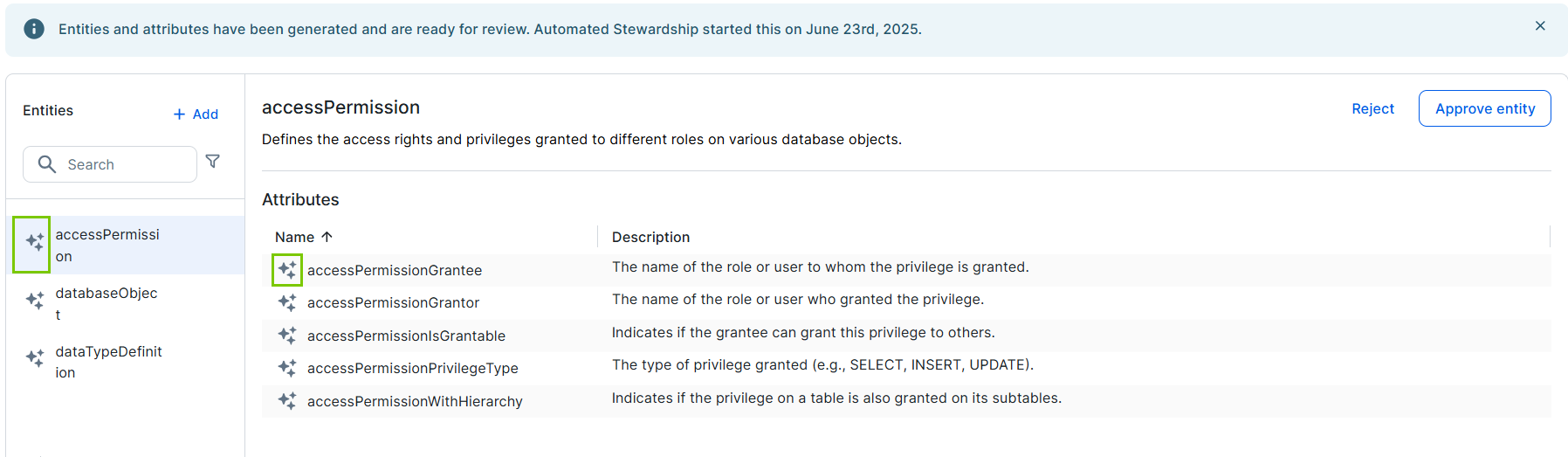
Once finished, the suggestions are available for both the entities and attributes. Suggestions are indicated with the Collibra AI icon.A Ready for review tag shows that suggestions were created. Hover over the tag to see the date the suggestions were created. The date updates whenever Collibra AI creates new suggestions. The tag remains visible until all suggestions are approved or rejected.
Review the generated data entity suggestions
For each suggested data entity, click the suggested data entity in the Entities list, validate the suggestion, and edit, approve, or reject it.
-
To edit the name or description of the entity:
- Double-click the name or the description in the details pane.
- Make your changes and click the Save icon.
- Approve the entity.
-
To approve an entity, click Approve entity.
The suggested entity is saved as a Data Entity asset in the data model and the icon of the entity in the page changes. -
To reject it, click Reject.
The data entity, including the suggested data attributes for that data entity are rejected. -
To request more suggestions, based on different data, click Extend model. If you do, you can define if you want to modify existing suggestions.
-
To discard all unapproved AI suggestions, click Discard all suggestions.
Tip Unaccepted suggestions generated by the Semantic layer AI agents are automatically removed from Collibra after 60 days.
Review the generated data attribute suggestions
For each suggested data attribute available for an approved Data Entity, validate the suggestion, and edit, approve, or reject it.
To view the suggested attributes, select the Data Entity from the Entities list.
Each page can show up to 20 attributes.

-
To edit an attribute name, double-click the name, make your changes, and click the Save icon.
-
To edit an attribute description, double-click the description, make your changes, and click the Update button.
-
If the suggested mapping of the attribute to a physical Column is incorrect, click the x icon for the column in the Column cell.
If the suggested mappings of the attribute to Business assets or Measures is incorrect, click the x icon respective cell. -
To approve a single attribute, in the Actions column, click the Check icon.
To approve multiple attributes at the same time, select the attributes on the page and click Approve above the table.
As a result:- The suggested attribute is saved as a Data Attribute asset in the data model.
- The icon of the attribute in the page changes
- The "Data Attribute represents Column" relation is automatically added to the columns for which this data attribute was suggested, linking the physical layer with the semantic layer.
- The "Business asset represents Data asset" relation is automatically added to the Business Asset assets to which this data attribute was mapped.
- The "Measure is calculated using Data Element" relation is automatically added to the Measure assets to which this data attribute was mapped.
-
To reject a single attribute, in the Actions column, click the Reject icon.
To reject multiple attributes at the same time, select the attributes on the page and click Reject above the table.
If you select both suggested and approved attributes, and click Reject, only the suggested attributes are deleted. -
To delete approved or suggested attributes, select the attributes on the page and click Delete above the table.
If you select both suggested and approved attributes, and click Delete, all selected attributes are deleted.
- You can't approve a data attribute if you haven't approved the data entity.
- The Select all checkbox applies only to the attributes on the current page.
- Unaccepted suggestions generated by the Semantic layer AI agents are automatically removed from Collibra after 60 days.
You can now map the physical layer and the created semantic layer. You can do this manually