Community structure best practices
Applies to: Community structure
Recommendation
Manage the complexity of your Community structure (depth and breadth of structure).
Align community structure with your ownership model.
Impact
- Easier to assign and manage governance tasks.
- Supports compliance with regulations which require clear ownership of the data, such as GDPR.
- Reduces time on ownership management.
- Simplifies and improves navigation, enhancing user experience and adoption.
- Aligns with organizational structure that is familiar for user community.
- Eliminates performance bottlenecks.
Recommended action
Communities are directly correlated to accountabilities and domains are directly related to responsibilities, so you should represent your community/domain structure like your organizational data ownership model (by function, geography, LoB, business process, and so on.) – this allows one to more easily assign and manage governance tasks, which also support regulatory requirements.
In RACI terms, assign accountabilities (owner, custodian, council member, ...) at the community level and assign responsibilities (steward, SME, stakeholder, ...) at the domain level. Assign author-level permissions to the domain-level roles.
In terms of the complexity of your model, follow these guidelines:
- 3 levels is optimal
- 5 levels is workable
- 7 is the maximum ever recommended, and only if absolutely necessary, if you want to avoid navigation and performance issues
Develop a naming convention you can standardize on for Communities and Domains. Avoid acronyms and other jargon that may not be clear to all users, thinking about how users may be searching through the model. Names should reference the actual metadata that the assets/domains/communities contain. Communities and Domains appear alphabetically ordered by name so if you need them to appear in a particular order, consider prefixing the names with numbers to allow that, for example, 01_Finance, 02_HR, ...)
Avoid creating domains and communities that you are not ready to start using. Best practice for simplicity and performance of your model is to wait until there is a relevant use case.
Review the Community/Domain structure with the user community in terms of the navigation experience as early in the process as possible to avoid time-consuming and complex re-work and to enhance adoption.
Collibra product capability it relates to
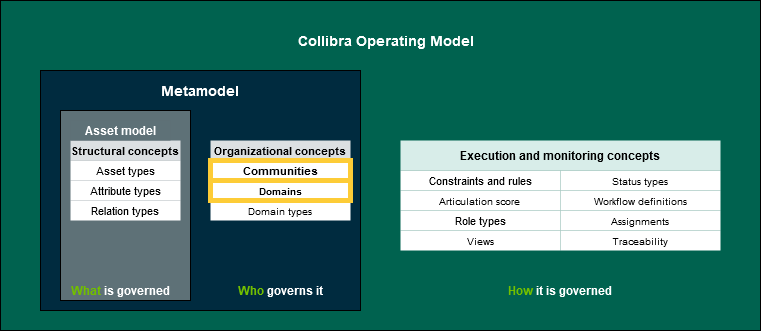
Operating Model
Topic area
Operating Model → Organizational Concepts → Communities, Domains
Validation criteria
Run the OMRE (Operating Model Reverse Engineering) on a regular basis to identify the elements above.
For more information see Collibra's Documentation Center:
- Communities: https://productresources.collibra.com/docs/collibra/latest/Content/Communities/co_communities.htm
- Domains: https://productresources.collibra.com/docs/collibra/latest/Content/Domains/co_domains.htm
- Resource roles: https://productresources.collibra.com/docs/collibra/latest/Content/DGCSettings/RolesAndPermissions/Roles/ResourceRoles/to_resource-roles.htm
- Resource permissions: https://productresources.collibra.com/docs/collibra/latest/Content/DGCSettings/RolesAndPermissions/Roles/ResourceRoles/to_resource-roles.htm