Add an Edge capability to authorize your Edge site to crawl the metadata and generate the technical lineage.Important Collibra Cloud sites do not support Shared Storage connections.
Required permissions
- You have a global role with the Product Rights > System administration global permission.
- You have a global role that has the Manage connections and capabilities global permission, for example, Edge integration engineer.
Steps
- Open a site.
-
On the main toolbar, click
 →
→
 Settings.
The Settings page opens. -
In the tab pane, click Edge.
The Sites tab opens and shows a table with an overview of your sites. - In the table, click the name of the site whose status is Healthy.
The site page opens.
-
On the main toolbar, click
- In the Capabilities section, click Add capability.
The Add capability page appears. - Select the Technical Lineage for SqlDirectory capability template.
- Enter the required information.
Field Description Required? Name
The name of the capability.
 Yes
Yes
Description
The description of the capability.
Yes
Capability template
The capability template. The value that you select in this field determines which sections appear on the page.
Select the following capability:
Technical Lineage for SqlDirectory Yes
Source ID
The name of the data source. The name must be unique and cannot contain special characters, for example,
/.If you change this value, the next synchronization adds another data source to the lineage instead of renaming the existing one. To change the source ID, delete the lineage for the existing data source first, then configure the new source ID.
For more information, go to About source IDs and the data source lifecycle.
Yes
TechLin Admin Connection (beta) If you want to use the OAuth authentication type to connect to the Collibra Data Lineage service instances, you have to create a Technical Lineage Admin Edge or Collibra Cloud site connection and select the OAuth authentication type. Then, in this field, specify the name of the Technical Lineage Admin connection.
For more information about the authentication types, go to Create a Technical Lineage Admin connection.
 No
No
Shared Storage Connection
The Shared Storage connection that you created.
No
Mask The pattern of the file names in the directory. By default, the value is
*. Yes
Dialect The dialect of the database.
See the list of allowed values.You can enter one of the following values:
azure, for an Azure SQL Server data source.bigquery, for a Google BigQuery data source.db2, for an IBM DB2 data source.hana, for an SAP HANA data source.hana-cviews, for getting lineage from calculated views in an SAP HANA Classic on-premises data source.hana-cviews-v2, for getting lineage from calculated views in an SAP HANA Cloud/Advanced data source.ImportantTo get technical lineage including calculated views, you must harvest SAP HANA by adding two Technical Lineage for SqlDirectory capabilities with the Shared Storage connections. In one capability, specify the
hanadialect, and in the other, specify thehana-cviewsorhana-cviews-v2dialect.hive, for a HiveQL data source.greenplum, for a Greenplum data source.mssql, for a Microsoft SQL Server data source.mysql, for a MySQL data source.netezza, for a Netezza data source.oracle, for an Oracle data source.postgres, for a PostgreSQL data source.redshift, for an Amazon Redshift data source.snowflake, for a Snowflake data source.spark, for a Spark SQL data source.sybase, for a Sybase data source.teradata, for a Teradata data source.
Yes
Collibra System Name
The system or server name of the data source. This field is also the full name of your System asset in Data Catalog.
The value of this field must be the same as the full name of the System asset that you created when you registered the data source.
Yes
Database The name of your database, which is also the name of your Database asset in Data Catalog.
Note The database and schema names in the SQL statements in your SQL files take precedence over the values that you provide for the Database and Schema fields in the technical lineage for SqlDirectory capability. If your SQL statements contain database and schema names, Collibra Data Lineage uses them for stitching. If your SQL statements do not contain database and schema names, Collibra Data Lineage uses the values of the Database and Schema fields in the capability for stitching. Fore more information, go to Prepare the SQL directory and Automatic stitching for technical lineage. Yes
Schema The name of the default schema, if not specified in the data source itself. This corresponds to the name of your Schema asset.
Note The database and schema names in the SQL statements in your SQL files take precedence over the values that you provide for the Database and Schema fields in the technical lineage for SqlDirectory capability. If your SQL statements contain database and schema names, Collibra Data Lineage uses them for stitching. If your SQL statements do not contain database and schema names, Collibra Data Lineage uses the values of the Database and Schema fields in the capability for stitching. Fore more information, go to Prepare the SQL directory and Automatic stitching for technical lineage. Yes
Database-System mapping This optional
More information and example configurationLet’s say you use the
Now let’s say that you have a SQL statement that selects data from a database DB2 (which is in SystemB) and inserts the data in database DB3 (which is part of SystemC). Both of these databases will be associated with SystemA, and both will appear under SystemA in the Browse tab pane. Therefore, stitching fails and duplicate databases might appear.
To resolve this issue and obtain stitching, you can use this
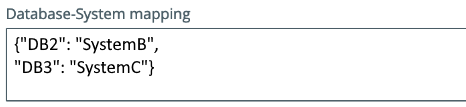 No
No
Property Use this section to define custom parameters for technical lineage. Click Add property to add a parameter.
Available propertiesType Value Type Name Descriptions Example value Text
Plaintext
httpTimeoutSets the HTTP timeout duration, in seconds. You can enter a value in the range of 1 to 3599. The default value is 15.
15Text Plaintext linkedServerDatabaseMapping
Specifies the database name to use when a linked server reference does not include a database. This value is used during lineage parsing to resolve incomplete object references.
{"LNKD1":"DB1","LNKD2":"DB2"}Text Plaintext linkedServerMapping
Defines a JSON mapping that maps SQL Server linked server names to Collibra system names. Collibra Data Lineage uses this mapping to resolve four-part linked server references during lineage parsing.
{"SRV1":"sys1","SRV2":"sys2"}Properties for Collibra Platform for Government customersType Value type Name Description Example value Text
Plaintext
techlinHostThis is the URL of the Collibra Data Lineage service instance to which you want to upload metadata.
techlin-europe-west1.collibra.comText
Secret
techlinKeyThis is the unique API key to connect to a Collibra Data Lineage service instance.
Specify a unique user key for each Collibra environment. If you're not sure what your user key is, contact your Collibra Collibra Account Team.
<your-techlin-key> Yes for US government customers.
Dependent On Sources
This option allows you to provide table-definition details from an independent data source to a data source that is dependent on those details. This is needed to avoid analysis errors and to have a complete lineage that includes lineage from the SQL statements from dependent data sources.
To use this option, enter the source ID of the independent source.
Show me an exampleLet's consider an example. Let's say that you want to create a technical lineage for two data sources:
Database1 contains the DDL that specifies that the database has a table named "Table1", which has three columns: Col1, Col2, Col3, and Col4.
Database2 contains an SQL statement: SELECT * from Database1.Schema1.Table1.
The SQL statement in Database2 refers to the table in Database1. Therefore, to get lineage from the statement in Database2, the table definition from Database1 must be known. In this case, we say that Database2 is dependent on Database1. Database1 is considered the independent data source.
To configure this option, specify the Source ID of the independent data source, in this example, Database1, as shown in the following imagee
 Important If a dependent data source contains lowercase column names, this feature will only work for the following dialects: Oracle, Snowflake, and Teradata. For all other dialects:
- An analyze error is raised, prompting you to provide the DDL file.
- The only workaround is to consolidate your SQL statements and DDL file in a single data source.
For complete information, go to Sharing database models across data sources.
Database Link Mapping If you are using DBLinks, this optional
The configuration format is as follows:
{"<dblink_name>": {"database":"<database>","schema":"<schema>"}, ...}The schema provided here is only taken into consideration if a schema is not explicitly specified in the SQL query. As such, the schema specified here can be considered a default or fallback mapping.
Tip If you’re using a DBLink to target another source, you need to share the databasae model between the targeted (independent) source and the dependent source. Use the
Show examplesLet's say that you have two Oracle data sources, A and B.
Source A
You have the following database configuration:
- Database_A > Schema_A1 > Table_1 > Column_1, Column_2
- Database_A > Schema_A2 > Table_2 > Column_x, Column_y
Source B
You have DBLinks with names
dblink.example.com,dblink2.example.com, anddblink3.example.com, all of which point to Source A.Tip Configure the
You want your DBLink aliases configured as follows:
- dblink.example.com → Database_A > Schema_A1
- dblink2.example.com → Database_A > Schema_A1
- dblink3.example.com → Database_A > Schema_A2
You specify this in the Database Link Mapping field as follows:
{
	"dblink.example.com": {"database":"Database_A","schema":"Schema_A1"},
	"dblink2.example.com": {"database":"Database_A","schema":"Schema_A1"},
	"dblink3.example.com": {"database":"Database_A","schema":"Schema_A2"}
	}
With this done, the following example queries on Source B are successfully analyzed by the Collibra Data Lineage service instance:
- select * from [email protected]
- select * from [email protected]
- select * from [email protected]
Multiple dblinks under the same database scope
You can configure multiple dblinks under the same database scope:
{
	"dbScope1": {
		"dblink.example.com": {
			"database": "Database_A",
			"schema": "Schema_A1"
		},
		"dblink2.example.com": {
			"database": "Database_A",
			"schema": "Schema_A1"
		},
		"dblink3.example.com": {
			"database": "Database_A",
			"schema": "Schema_A1"
		}
	}
}
Multiple dblinks under the same schema scope
You can configure multiple dblinks under the same schema scope. In the following example,
DB1is scoped for the entire database.DB2is scoped based on the schema.{ "DB1": { "[DB LINK NAME]": { "database": "[REMOTE DATABASE NAME]", "schema": "[REMOTE DATABASE DEFAULT SCHEMA]" } }, "DB2": { "SCHEMA1": { "[DB LINK NAME]": { "database": "[REMOTE DATABASE NAME]", "schema": "[REMOTE DATABASE DEFAULT SCHEMA]" } }, "SCHEMA2": { "[DB LINK NAME]": { "database": "[REMOTE DATABASE NAME]", "schema": "[REMOTE DATABASE DEFAULT SCHEMA]" } } } }Important If the same DBLink, for exampledblink.example.com, exists in multiple databases, the formatting shown in the previous example still applies, but you need to enclose it in curly brackets and specify the relevant database, as follows:- Basic formatting, as shown in the previous example:
"dblink.example.com": {"database":"Database_A","schema":"Schema_A1"} - Formatting if the DBLink exists in multiple databases and you want to apply it only in a database named "dbScope1":
"dbScope1": {"dblink.example.com": {"database":"Database_A","schema":"Schema_A1"}}
If a DBLink is referenced in multiple mappings, as shown in the following example, the first mapping is used.
"dbScope1": {
   "dblink.example.com": {"database":"DevDB_A","schema":"DevSch_A1"}
},
   "dblink.example.com": {"database":"Database_A","schema":"Schema_A1"}}
In this case, occurrences of
dblink.example.comin the database named "dbScope1" are mapped to:"database":"DevDB_A","schema":"DevSch_A1" No
Delete Raw Metadata After Processing
Technical lineage via Edge harvests raw metadata from specified data sources and uploads it in a ZIP file to a Collibra Data Lineage service instance. This option indicates whether the raw metadata should be deleted from the Collibra Data Lineage service instance after the metadata that is targeted for ingestion in Data Catalog is processed.
Select this option to indicate that the raw source metadata is deleted after processing.
Clear the checkbox to keep the raw source metadata after processing. In this case, it is stored in the Collibra infrastructure.
No
Analyze Only (Deprecated)
Important This option is deprecated and will be removed in a future version of Collibra. We recommend that you no longer use it. The mandatory Processing Level setting, below, replaces this option.- The "Analyze" option in the Processing Level setting is the equivalent of selecting the Analyze Only option.
- The "Sync" option in the Processing Level setting is the equivalent of clearing the Analyze Only option.
No
Important This setting replaces the deprecated Analyze Only option, which will be removed in a future version of Collibra.
For each of your data sources, you have to specify one of the following values: Load, Analyze, or Sync. Then, when you synchronize your technical lineage, the following process begins:
- Metadata for all data sources is loaded, regardless of the value of this setting for a particular data source.
- Metadata from data sources for which the value of this setting is either Analyze or Sync, is analyzed.
- Metadata from data sources for which the value of this setting is Sync, is synchronized.
Value Description Load Harvest metadata from the data source and upload it to your Collibra environment. This allows you to inspect and, if necessary, edit the harvested metadata before uploading it to the Collibra Data Lineage service instance for analysis.
When the job is done, you can download and review the metadata. The ZIP file is available for 8 hours after the job completes. If the file is no longer available, run the job again and download the file from the new run.
- Open the Activities list.
-
In the row containing the job, click Result.
The Synchronization Results dialog box appears.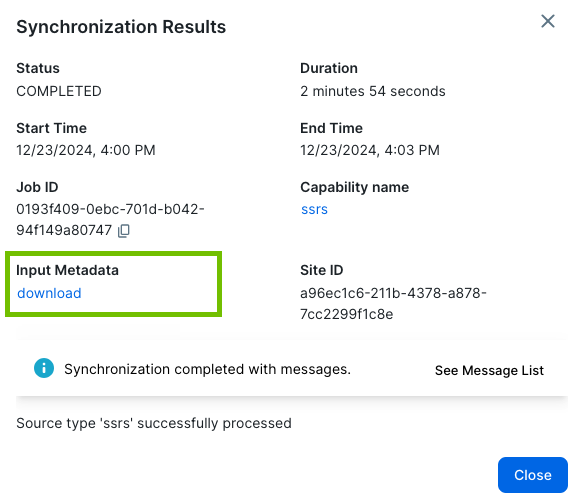
- Click download and save the ZIP file to your hard drive.
Tip The download link resembles the following:
https://integrations.collibra-abc.com/rest/2.0/files/01944f12-7665-7d9c-8bc5-aa426b6a63cc. Take note of the file ID, in this example:01944f12-7665-7d9c-8bc5-aa426b6a63cc. After you inspect the metadata, you can send the ZIP file for analysis by using the "Analyze files" option. Alternatively, you can upload the ZIP file using the POST /files API. In either case, you need to specify the file ID.Analyze Load and analyze the metadata on the Collibra Data Lineage service instance.
Synchronization does not start after analysis; it starts only after either:
- You trigger synchronization of another data source for which you specify Sync in the Processing Level drop-down list.
- You configure the Technical Lineage Admin Edge or Collibra Cloud site capability, and trigger synchronization via the Sync option in the Integration Configuration tab in Data Catalog.
Important If you want to synchronize multiple data sources, we strongly recommend that you select this option in the respective Edge or Collibra Cloud site capabilities for each of your data sources. This allows you to synchronize all data sources in a single job, thereby maximizing efficiency and mitigating the risk of failed synchronization jobs.- For complete information and important considerations, go to Tips for successful lineage synchronization
- For more information about the Sync option in the Technical Lineage Admin Edge or Collibra Cloud site capability, go to Technical lineage admin options.
Sync Load, analyze, and synchronize metadata from all data sources. Synchronization starts – or is queued, if another synchronization job is running – immediately after analysis.
Important If you want to synchronize multiple data sources and you select this option, each data source is processed as a separate job. This is highly inefficient and will likely lead to failed sync jobs. For complete information and important considerations, go to Tips for successful lineage synchronization.
No
Active
The option determines whether to include or remove the technical lineage of the data source.
Select this option to include the technical lineage of this data source.
Clear the checkbox to exclude the technical lineage of this data source.
Yes
- Click Add.
The capability is added to the Edge or Collibra Cloud site.
The fields become read-only.

You can now synchronize the technical lineage.