Important This feature is in preview and only available on the latest UI. It is not enabled by default and must be activated on your Collibra instance by Collibra Support. For more information, go to this knowledge article.
Synchronizing outbound metadata via the Databricks Unity Catalog integration is the process of propagating attribute values from Collibra to tags in Databricks Unity Catalog, as mapped in the outbound configuration. Once you have set it up, outbound synchronization runs automatically every 5 minutes if there are outbound events to process.
The outbound flow is supported for Database, Schema, Table, Database View, and Column assets. If any tag name/value is left blank, the outbound synchronization will remove the tag from the asset in Databricks Unity Catalog. The integration supports mapping the following two types of tags to Databricks Unity Catalog:- Custom tags: Custom tags accept any user-defined key-value pair. These are suitable for asset attributes such as description or any other custom attributes where the possible values are not predefined.
- Governed tags: Governed tags are a subset of custom tags. These are linked to tag policies in Databricks Unity Catalog that define allowed values. In contrast to custom tags, governed tags are ideal for attributes such as status, where all possible values are known in advance. Note that governed tags only accept predefined allowed values and reject any others. If you assign a tag value that is not allowed, it will not be propagated to the governed tag in Databricks Unity Catalog. In this case, the new value will appear in the asset attribute but the associated governed tag will remain unchanged. For attributes with multiple values, the combined, semicolon-separated value must itself match an allowed value, so use a custom tag or policy that allows the combined values. For more information on governed tags, go to the Databricks Unity Catalog documentation.
- Note
- Outbound synchronization is only supported for assets ingested through the Databricks Unity Catalog integration, and not for assets ingested through a JDBC data source using the scalable ingestion flow.
- Support for outbound synchronization of attributes such as responsibilities, data classification, articulation scores, Collibra tags, and data quality scores from Collibra to Databricks Unity Catalog will be added in the future.
Prerequisites
In your Collibra environment:
- To configure outbound synchronization using the Databricks Unity Catalog integration, you need:
- Collibra Platform 2026.03 or newer.
- Edge 2026.3.21 or newer.
- You have integrated metadata from Databricks Unity Catalog to Collibra Platform.
- When you created the Databricks Unity Catalog connection, you granted the necessary permissions in Databricks Unity Catalog for outbound synchronization.
- If you're using an Edge site older than version 2025.10.126, you must rerun the inbound metadata synchronization for tag mappings to be applied to database and schema assets in Databricks Unity Catalog.
Steps
Manually synchronize Databricks Unity Catalog:
-
On the main toolbar, click
 →
→
 Catalog.
The Catalog homepage opens. - Click Integrations.
The Integrations page opens. - Click the Integration configuration tab.
- Locate the Databricks connection that you used when you added the Databricks Unity Catalog capability and click the link in the Capabilities column.
The synchronization configuration page opens. - Select the Metadata outbound tab and then click Add configuration.
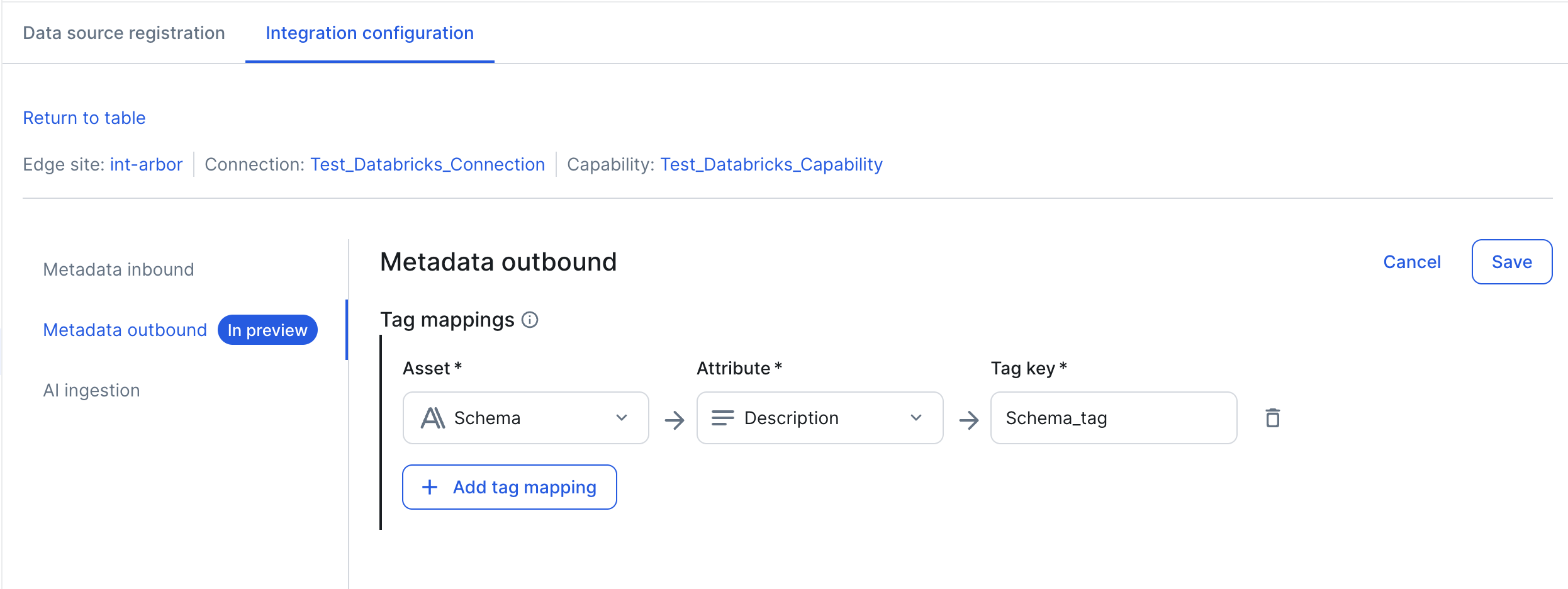
- In the Tag mappings section, click Add tag mapping to add a new tag mapping:
- In the Asset field, select the supported asset type to which you want to apply the tag mapping. If you do not specify an asset type, the tag mapping will apply to all applicable asset types by default.
- In the Attribute field, select the attribute whose value you want to send to Databricks Unity Catalog. Attributes with multiple values are also supported. Their selected values are combined into a single Databricks tag value joined with a semicolon (
;). For example,Finance;HR;Legal. - In the Tag key field, specify the value to be mapped in Databricks Unity Catalog for the selected attribute.
- Click Save.
Outbound synchronization runs automatically every 5 minutes if there are outbound events to process.
Example Once you have configured outbound synchronization, you can make changes to your selected attributes in Collibra, and these changes will be mapped in Databricks Unity Catalog. For example, if you update the description of the flight_boarding Table asset in Collibra from Tracks real-time passenger entry. to Logs passenger boarding times., the description for the Table asset will be updated in Databricks Unity Catalog after outbound synchronization is completed.
The synchronization job synchronizes the Databricks Unity Catalog data.
After the outbound synchronization:
- You can view a summary of the results in the Activities tab.
- You can view the propagated attribute values in Databricks Unity Catalog.