After you have created a connection to Tableau in your Edge or Collibra Cloud site, you have to add the Tableau technical lineage capability to the connection.
Required permissions
- You have a global role with the Product Rights > System administration global permission.
- You have a global role that has the Manage connections and capabilities global permission, for example, Edge integration engineer.
Steps
- Open a site.
-
On the main toolbar, click
 →
→
 Settings.
The Settings page opens. -
In the tab pane, click Edge.
The Sites tab opens and shows a table with an overview of your sites. - In the table, click the name of the site whose status is Healthy.
The site page opens.
-
On the main toolbar, click
- In the Capabilities section, click Add capability.
The Add capability page appears. - Select the Technical Lineage for Tableau capability template.
- Enter the required information.
Field Description Required Name
The name of the capability.
 Yes
Yes
Description
The description of the capability.
 No
No
Source ID
The name of the data source. The name must be unique and cannot contain special characters, for example,
/.Warning- You can only specify one source ID per Tableau server or Tableau online account. Ingesting the same server or only account under different source IDs will fail.
- Any single server or only account can be ingested only once. If you create more than one connection for the same server or only account, integration will fail. If you want to ingest from multiple unique server or only account, you have to create a new Edge connection for each one, configure a new capability template for each one, and each must have a unique source ID.
- We recommend that you do not change the source ID after the initial configuration. For BI data sources, changing the source ID can cause synchronization to fail. If you need to change the source ID, first delete the lineage for the existing data source, and then configure the new source ID. For more information, go to About source IDs and the data source lifecycle.
- If you are switching between the lineage harvester and Edge, the value in this field must exactly match the value of the
idproperty in your lineage harvester configuration file.
Yes
TechLin Admin Connection (beta) If you want to use the OAuth authentication type to connect to the Collibra Data Lineage service instances, you have to create a Technical Lineage Admin Edge or Collibra Cloud site connection and select the OAuth authentication type. Then, in this field, specify the name of the Technical Lineage Admin connection.
For more information about the authentication types, go to Create a Technical Lineage Admin connection.
No
Tableau connection
The Tableau connection that you created for ingestion in Data Catalog.
Tip Select the name that you provided in the Name field when you created a connection to Tableau.
Yes
Domain ID
The unique reference ID of the domain in Collibra Platform in which you want to ingest the Tableau assets.
To move existing BI assets to a different domain, update this field and the domainId property in the source configuration, and then synchronize the capability again. For more information, go to Move BI assets to a different domain.
How do I find a domain reference ID?Open the relevant domain in Collibra. The URL looks like: https://<yourcollibrainstance>/domain/22258f64-40b6-4b16-9c08-c95f8ec0da26?view=00000000-0000-0000-0000-000000040001. In this example, the reference ID is in bold.
Yes
REST only
Indication whether or not you want to use both the Tableau REST API and Tableau Metadata API to harvest Tableau metadata.
- Cleared: The lineage harvester will use the REST API and Metadata API to harvest Tableau metadata.
- Selected (default): The lineage harvester will only use the REST API to harvest Tableau metadata.
Note This field must be cleared, to:- Enable technical lineage and the automatic stitching of Column assets to Tableau Data Attribute assets.
- Harvest owner information for Tableau projects, workbooks and data models.
No
Exclude images
Indication whether or not you want to excluding the downloading of images.
- Cleared: Images are downloaded.
- Selected (default): Images are not downloaded.
Note The maximum number of images that can be uploaded to Collibra per day is determined by the configuration of the file upload service, in Collibra Console. For complete details, see the Upload configuration settings in DGC service configuration: options.
No
Site ID
The site IDs of the Tableau sites that you want to include in the ingestion process.
To ingest from multiple Tableau sites, enter each site ID in a separate Site ID field.
To ingest the default Tableau site, enter "Default" or leave the field empty. This field is not case sensitive.
Warning If you enter "Default", you must include the double quotation marks. The site IDs of any other Tableau sites must not be enclosed in double quotation marks. If the formatting of the site IDs does not conform to this detail, ingestion will fail.ExampleShow an exampleLet's say that you want to ingest from the default Tableau site and a site named ABC.
- In the Site ID field, enter "Default" for the default Tableau site.
- Click Add property.
An empty Site ID field is aded. - In the new Site ID field, enter the ID of the Tableau site ABC.
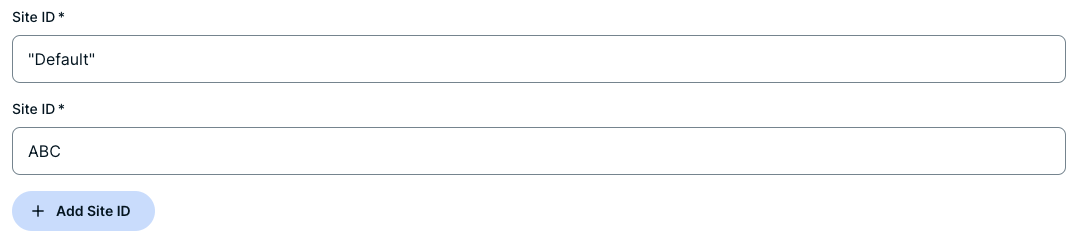
Tip Ensure that you specify the correct value. The correct value is the URL of the site to which you want to sign in. When you manually sign in to Tableau Server or Tableau Online, the site ID is the value that appears after /site/ in the browser address bar. In the following example URLs, the site ID isMarketingTeam:- Tableau Server: http://MyServer/#/site/MarketingTeam/projects
- Tableau Online: https://10ay.online.tableau.com/#/site/MarketingTeam/workbooks
On Tableau Server, however, the URL of the default site does not specify the site. For example, the URL for a view named Profits, on a site named Sales, is http://localhost/#/site/sales/views/profits. The URL for this same view on the default site is http://localhost/#/views/profits. The site name Sales does not figure in the URL. Yes
Site Name
The site name, or names, of the Tableau sites you specified in the Site ID field.
If you don't provide a site ID in the Site ID field, or if you enter "Default", leave this field empty.
You must enter a name for every site ID you enter.
Concurrency level
This field is intended to help if you are experiencing HTTP 401 Unauthorized errors due to too many concurrent HTTP calls, using the same token. It allows you to specify the internal sizing, meaning the amount of tasks that can be executed at the same time.
The default value is
10, meaning as many as 10 HTTP requests can take place in parallel. Consider reducing the value if you are experiencing HTTP 401 Unauthorized errors. Setting the value to1effectively disables the concurrency level, so that HTTP requests will be run in a synchronous manner, instead of in parallel. No
Source configuration
The JSON configuration for database mapping, domain mapping, and project filtering.
This field has a size limit. If your JSON content exceeds 256 KB, do not use this field. Instead, use the Source Configuration File field to prevent the synchronization job from failing.
Specify the properties in JSON format and enter the content in this field. For property details and example JSON, go to Tableau source configuration.
No
Source Configuration File
An alternative to the Source Configuration field. Upload a .json file that contains your source configuration.
This file is required if your JSON content exceeds 256 KB, because large JSON strings provided in the Source Configuration field can cause the synchronization job to fail.
For details on the JSON content, go to Tableau source configuration.
No
Property Use this section to define custom parameters for technical lineage. Click Add property to add a parameter.
Available properties:Type Value Type Name Descriptions Example value Text
Plaintext
httpTimeoutSets the HTTP timeout duration, in seconds. You can enter a value in the range of 1 to 3599. The default value is 15.
15Properties for Collibra Platform for Government customersType Value type Name Description Example value Text
Plaintext
techlinHostThis is the URL of the Collibra Data Lineage service instance to which you want to upload metadata.
techlin-europe-west1.collibra.comText
Secret
techlinKeyThis is the unique API key to connect to a Collibra Data Lineage service instance.
Specify a unique user key for each Collibra environment. If you're not sure what your user key is, contact your Collibra Collibra Account Team.
<your-techlin-key> Yes for US government customers.
Dependent On Sources
This option allows you to provide table-definition details from an independent data source to a data source that is dependent on those details. This is needed to avoid analysis errors and to have a complete lineage that includes lineage from the SQL statements from dependent data sources.
To use this option, enter the source ID of the independent source.
Show me an exampleLet's consider an example. Let's say that you want to create a technical lineage for two data sources:
Database1 contains the DDL that specifies that the database has a table named "Table1", which has three columns: Col1, Col2, Col3, and Col4.
Database2 contains an SQL statement: SELECT * from Database1.Schema1.Table1.
The SQL statement in Database2 refers to the table in Database1. Therefore, to get lineage from the statement in Database2, the table definition from Database1 must be known. In this case, we say that Database2 is dependent on Database1. Database1 is considered the independent data source.
To configure this option, specify the Source ID of the independent data source, in this example, Database1, as shown in the following imagee
 Important If a dependent data source contains lowercase column names, this feature will only work for the following dialects: Oracle, Snowflake, and Teradata. For all other dialects:
- An analyze error is raised, prompting you to provide the DDL file.
- The only workaround is to consolidate your SQL statements and DDL file in a single data source.
For complete information, go to Sharing database models across data sources.
No
Delete Raw Metadata After Processing
Technical lineage via Edge harvests raw metadata from specified data sources and uploads it in a ZIP file to a Collibra Data Lineage service instance. This option indicates whether the raw metadata should be deleted from the Collibra Data Lineage service instance after the metadata that is targeted for ingestion in Data Catalog is processed.
Select this option to indicate that the raw source metadata is deleted after processing.
Clear the checkbox to keep the raw source metadata after processing. In this case, it is stored in the Collibra infrastructure.
Analyze Only (Deprecated)
Important This option is deprecated and will be removed in a future version of Collibra. We recommend that you no longer use it. The mandatory Processing Level setting, below, replaces this option.- The "Analyze" option in the Processing Level setting is the equivalent of selecting the Analyze Only option.
- The "Sync" option in the Processing Level setting is the equivalent of clearing the Analyze Only option.
No
Important This setting replaces the deprecated Analyze Only option, which will be removed in a future version of Collibra.
For each of your data sources, you have to specify one of the following values: Load, Analyze, or Sync. Then, when you synchronize your technical lineage, the following process begins:
- Metadata for all data sources is loaded, regardless of the value of this setting for a particular data source.
- Metadata from data sources for which the value of this setting is either Analyze or Sync, is analyzed.
- Metadata from data sources for which the value of this setting is Sync, is synchronized.
Value Description Load Harvest metadata from the data source and upload it to your Collibra environment. This allows you to inspect and, if necessary, edit the harvested metadata before uploading it to the Collibra Data Lineage service instance for analysis.
When the job is done, you can download and review the metadata. The ZIP file is available for 8 hours after the job completes. If the file is no longer available, run the job again and download the file from the new run.
- Open the Activities list.
-
In the row containing the job, click Result.
The Synchronization Results dialog box appears.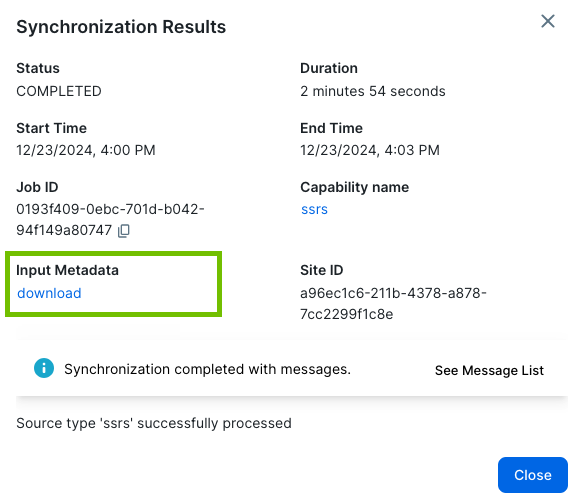
- Click download and save the ZIP file to your hard drive.
Tip The download link resembles the following:
https://integrations.collibra-abc.com/rest/2.0/files/01944f12-7665-7d9c-8bc5-aa426b6a63cc. Take note of the file ID, in this example:01944f12-7665-7d9c-8bc5-aa426b6a63cc. After you inspect the metadata, you can send the ZIP file for analysis by using the "Analyze files" option. Alternatively, you can upload the ZIP file using the POST /files API. In either case, you need to specify the file ID.Analyze Load and analyze the metadata on the Collibra Data Lineage service instance.
Synchronization does not start after analysis; it starts only after either:
- You trigger synchronization of another data source for which you specify Sync in the Processing Level drop-down list.
- You configure the Technical Lineage Admin Edge or Collibra Cloud site capability, and trigger synchronization via the Sync option in the Integration Configuration tab in Data Catalog.
Important If you want to synchronize multiple data sources, we strongly recommend that you select this option in the respective Edge or Collibra Cloud site capabilities for each of your data sources. This allows you to synchronize all data sources in a single job, thereby maximizing efficiency and mitigating the risk of failed synchronization jobs.- For complete information and important considerations, go to Tips for successful lineage synchronization
- For more information about the Sync option in the Technical Lineage Admin Edge or Collibra Cloud site capability, go to Technical lineage admin options.
Sync Load, analyze, and synchronize metadata from all data sources. Synchronization starts – or is queued, if another synchronization job is running – immediately after analysis.
Important If you want to synchronize multiple data sources and you select this option, each data source is processed as a separate job. This is highly inefficient and will likely lead to failed sync jobs. For complete information and important considerations, go to Tips for successful lineage synchronization.
No
Active
The option determines whether to include or remove the technical lineage of the data source.
Select this option to include the technical lineage of this data source.
Clear the checkbox to exclude the technical lineage of this data source.
No
Paging
This option allows you to customize the Tableau API pagination settings.
The default values are sufficient in most cases; however, you can decrease them to help mitigate node limit errors, or increase them to speed up API calls.
If the integration fails because of timeout errors due to page sizing limits, Collibra Data Lineage automatically adjusts the limits and retries. For example, if failure occurs with
worksheetsPageSizeset to 100, the value is automatically reduced to 50 and another integration attempt is automatically started. If it fails again, the value is again halved. If integration is still unsuccessful with an adjusted value of 1, an error is thrown and no further attempts are started. If integration is eventually successful, the page size value is restored to its original value, in this example 100, for the next synchronization.The complete list of pagination settings, descriptions and default values"paging": { "databasesPageSize": 100, "tablesPageSize": 100, "tablesColumnsPageSize": 100, "tableColumnsPageSize": 1000, "datasourcesPageSize": 50, "datasourcesFieldsPageSize": 50, "datasourceFieldsPageSize": 100, "worksheetsPageSize": 100, "worksheetsFieldsPageSize": 100, "worksheetFieldsPageSize": 1000, "usersPageSize": 100, "dashboardsPageSize": 100, "columnsLimit": 20, "fieldsLimit": 20 }Settings per metadata type and descriptions
Metadata type Setting and description Dashboard dashboardsPageSize: The number of dashboards per page.
Worksheet worksheetsPageSize: The number of worksheets per page.worksheetsFieldsPageSize: The number of worksheet fields per page.
Database databasesPageSize: The number of databases per page.
Table tablesPageSize: The number of tables per page.tablesColumnsPageSize: The number of table columns per page.
Table columns tableColumnsPageSize: The number of table columns per page.
Users usersPageSize: The number of users per page.
Data source datasourcesPageSize: The number of data sources per page.datasourcesFieldsPageSize: The number of data source fields per page.columnsLimit: The number of data source field columns per page.fieldsLimit: The number of referenced data source fields per page.
Data source field datasourceFieldsPageSize: The number of data source fields per page.columnsLimit: The number of data source field columns per page.fieldsLimit: The number of referenced data source fields per page.
No
Debug
This setting is not valid for this integration. It should be set to false.
No
Log level
Only complete this field on the request of or together with Collibra Support.
No
- Click Add.
The capability is added to the Edge or Collibra Cloud site.
The fields become read-only.

You can now synchronize the technical lineage.