To retrieve data from Strategy, you have to connect to Strategy via the Edge site.
Prerequisites
- You have a global role with the Product Rights > System administration global permission.
- You have a global role that has the Manage Edge sites global permission.
- You have a global role that has the Manage connections and capabilities global permission.
- You have a resource role with the Configure external system resource permission, for example, Owner.
- You have the necessary Strategy permissions.
- You have added a vault to your Edge site.Note Vaults are not supported on Collibra Cloud sites.
- If your data source connection requires a file from your vault, the file must be encoded into Base64 and stored as a regular secret in your vault.
Steps
- Open a site.
-
On the main toolbar, click
 →
→
 Settings.
The Settings page opens. -
In the tab pane, click Edge.
The Sites tab opens and shows a table with an overview of your sites. - In the site overview, click the name of a site.
The site page appears.
-
On the main toolbar, click
-
In the Connections section, click Create Connection.
The Create Connection dialog box appears. - Select MicroStrategy connection.
- Enter the required information.
Field Description Required Name The name of the connection. The name can be anything, as long as it is unique.
Tip The name that you provide here is the name you have to select in the MicroStrategy connection field, when adding the Technical Lineage for MicroStrategy capability to the Edge site.
 Yes
Yes
Description The description of the connection.  No
No
Vault The vault where you store your data source values. No
MicroStrategy URL
The URL of your Strategy Intelligence Server.
How to use your vault...To use your vault, do the following:- In the Value Type field, select Vault Key.
- Enter the query value to identify the secret in your vault.Example
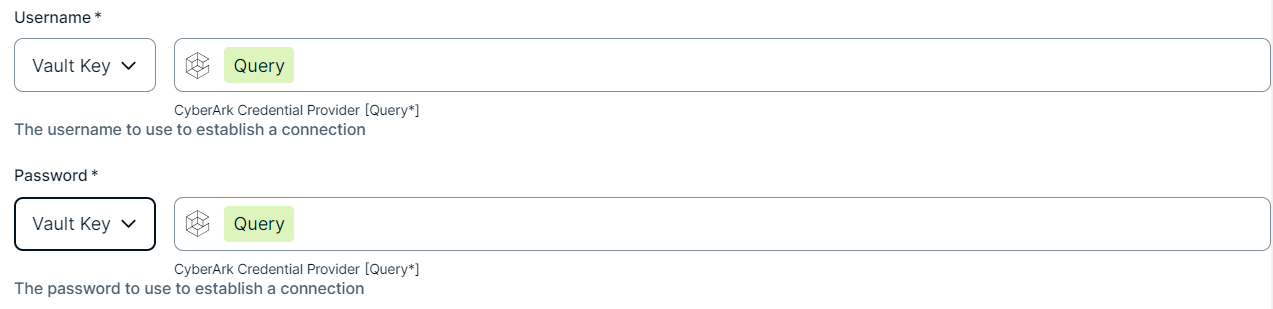 Note The Query must be a string containing the properties required to identify the secret. Each property must be separated by a semicolon (;). For example: Safe=<SafeName>;Folder=<FolderName>;Object=<ObjectName>
If a property is a folder with sub-folders, use a backslash (\) to define the folder path. For example: Folder=Root\Top Secrets\More Secrets
For more information about query formats and supported properties, go to the CyberArk Credential Provider documentation.
To use your vault, do the following:- In the Value Type field, select Vault Key.
- Enter the required information:
- Secret Engine Type
- Select one of the following:
- Key Value
- Database
- Engine Path
- The engine path to your vault where the value is stored.
- Secret Path
- The secret path to your vault where the value is stored.
- Field
- If your Secret Engine Type is Key Value, enter the name of the field to your vault where the value is stored.
- Role
- If your Secret Engine Type is Database, enter the role specified in the Database engine.
Example
To use your vault, do the following:- In the Value Type field, select Vault Key.
- Enter the required information:
- Vault Name
- The name of your Azure Key Vault in your Azure Key Vault service where the value is stored.
- Secret Name
- The name of the secret in your vault where the value is stored.
Example
To use your vault, do the following:- In the Value Type field, select Vault Key.
- Enter the required information:
- Secret Name
- The name of the secret in your vault where the value is stored.
- Field
- If the secret stored in your AWS Secrets Manager is a JSON value, for example
{"pass1": "my-password", "pass2": "my-password2"}, then you need to specify the Field to point to the exact JSON value that should be used. For example,Secret Name: edge-db-customer; Field: pass.Note If the secret stored in your AWS Secrets Manager is a plain string value, for examplemy-password, then you do not need to specify the Field.
Example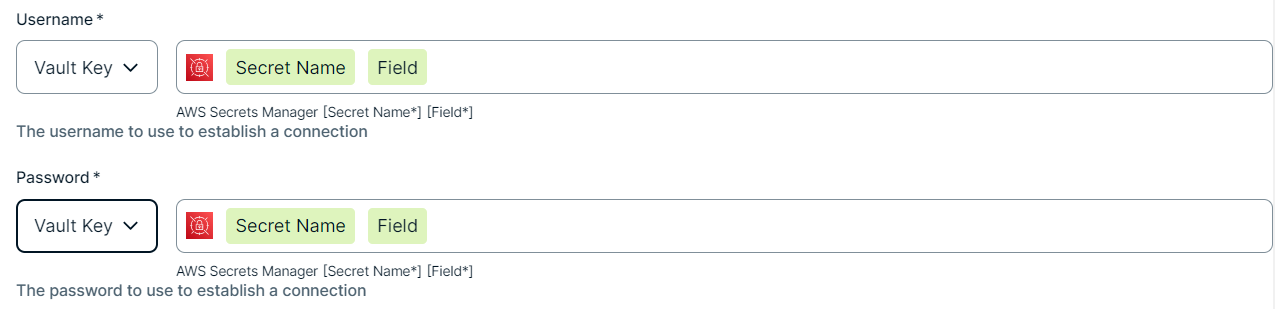
To use your vault, do the following:- In the Value Type field, select Vault Key.
- Enter the name of the secret in your vault where the value is stored.
Example

Yes
Authentication Type The authentication type you can use to connect to Strategy. Select one of the following types:
- Basic Authentication (Username/Password)
- Use the username and password authentication type.
- Token based authentication
- Use the token based authentication.
No
Username The username that you use to sign in to Strategy. This is required when you select the basic authentication type.
Ignore this field if you select the token based authentication type.
How to use your vault...To use your vault, do the following:- In the Value Type field, select Vault Key.
- Enter the query value to identify the secret in your vault.ExampleNote The Query must be a string containing the properties required to identify the secret. Each property must be separated by a semicolon (;). For example: Safe=<SafeName>;Folder=<FolderName>;Object=<ObjectName>
If a property is a folder with sub-folders, use a backslash (\) to define the folder path. For example: Folder=Root\Top Secrets\More Secrets
For more information about query formats and supported properties, go to the CyberArk Credential Provider documentation.
To use your vault, do the following:- In the Value Type field, select Vault Key.
- Enter the required information:
- Secret Engine Type
- Select one of the following:
- Key Value
- Database
- Engine Path
- The engine path to your vault where the value is stored.
- Secret Path
- The secret path to your vault where the value is stored.
- Field
- If your Secret Engine Type is Key Value, enter the name of the field to your vault where the value is stored.
- Role
- If your Secret Engine Type is Database, enter the role specified in the Database engine.
Example
To use your vault, do the following:- In the Value Type field, select Vault Key.
- Enter the required information:
- Vault Name
- The name of your Azure Key Vault in your Azure Key Vault service where the value is stored.
- Secret Name
- The name of the secret in your vault where the value is stored.
Example
To use your vault, do the following:- In the Value Type field, select Vault Key.
- Enter the required information:
- Secret Name
- The name of the secret in your vault where the value is stored.
- Field
- If the secret stored in your AWS Secrets Manager is a JSON value, for example
{"pass1": "my-password", "pass2": "my-password2"}, then you need to specify the Field to point to the exact JSON value that should be used. For example,Secret Name: edge-db-customer; Field: pass.Note If the secret stored in your AWS Secrets Manager is a plain string value, for examplemy-password, then you do not need to specify the Field.
Example
To use your vault, do the following:- In the Value Type field, select Vault Key.
- Enter the name of the secret in your vault where the value is stored.
Example
No
Password/Token If you select the basic authentication type, enter the password that you use to sign in to Strategy.
If you select the token based authentication type, enter the token that you configured. Use the
/apiTokensAPI to get the token. For more information, go to Strategy REST.How to use your vault...To use your vault, do the following:- In the Value Type field, select Vault Key.
- Enter the query value to identify the secret in your vault.ExampleNote The Query must be a string containing the properties required to identify the secret. Each property must be separated by a semicolon (;). For example: Safe=<SafeName>;Folder=<FolderName>;Object=<ObjectName>
If a property is a folder with sub-folders, use a backslash (\) to define the folder path. For example: Folder=Root\Top Secrets\More Secrets
For more information about query formats and supported properties, go to the CyberArk Credential Provider documentation.
To use your vault, do the following:- In the Value Type field, select Vault Key.
- Enter the required information:
- Secret Engine Type
- Select one of the following:
- Key Value
- Database
- Engine Path
- The engine path to your vault where the value is stored.
- Secret Path
- The secret path to your vault where the value is stored.
- Field
- If your Secret Engine Type is Key Value, enter the name of the field to your vault where the value is stored.
- Role
- If your Secret Engine Type is Database, enter the role specified in the Database engine.
Example
To use your vault, do the following:- In the Value Type field, select Vault Key.
- Enter the required information:
- Vault Name
- The name of your Azure Key Vault in your Azure Key Vault service where the value is stored.
- Secret Name
- The name of the secret in your vault where the value is stored.
Example
To use your vault, do the following:- In the Value Type field, select Vault Key.
- Enter the required information:
- Secret Name
- The name of the secret in your vault where the value is stored.
- Field
- If the secret stored in your AWS Secrets Manager is a JSON value, for example
{"pass1": "my-password", "pass2": "my-password2"}, then you need to specify the Field to point to the exact JSON value that should be used. For example,Secret Name: edge-db-customer; Field: pass.Note If the secret stored in your AWS Secrets Manager is a plain string value, for examplemy-password, then you do not need to specify the Field.
Example
To use your vault, do the following:- In the Value Type field, select Vault Key.
- Enter the name of the secret in your vault where the value is stored.
Example
Yes
- Click Create.
Add the Technical Lineage for MicroStrategy capability to your Edge or Collibra Cloud site.