The semantic layer, also referred to as logical data layer, defines data structures within an organization's system in the Guided Stewardship operating model.
Note Although the System asset type is a Technology Asset, it adds higher-level structure to the semantic layer and is considered part of this layer.
The semantic layer consists of the following asset types: System, Data Model, Data Entity, and Data Attribute.
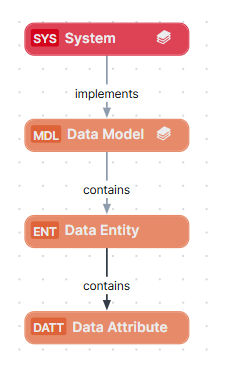
The semantic layer is a tree-like structure, starting with a high-level System and Data Model assets, and branching out with implementation-specific Data Entity and Data Attribute assets.

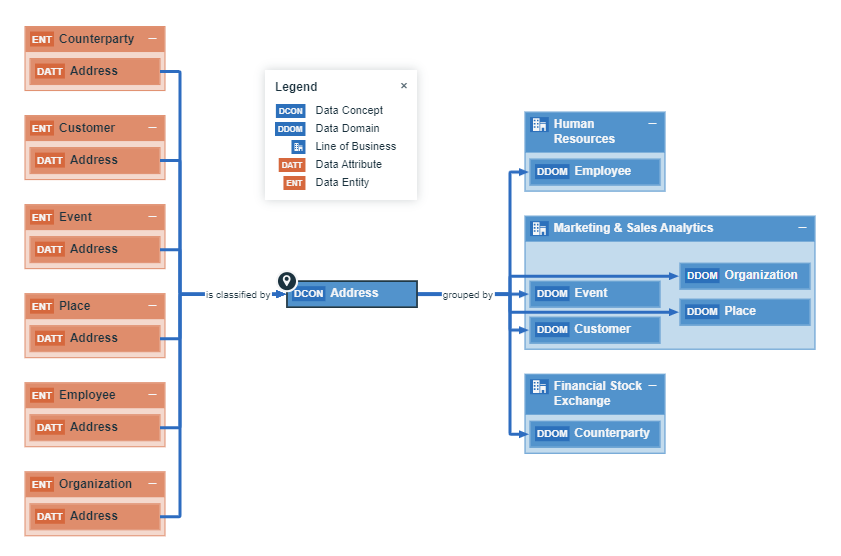
The Data Attribute Address can be used in several Data Entities, such as Customer Address, Event Address and Employee Address.
The Data Model asset is the highest level of organizational structure in the semantic layer, and defines the specific structure of data in a System.
Example .....
Data Model assets are:
|
Related to... |
Via the relation type... |
Description |
|---|---|---|
| System assets | System implements / is implemented in Data Model |
One-to-one relation, whereby:
Note The one-to-one nature of this relationship is what makes Data Models – and, therefore, the entire logical data layer – context-dependent, as opposed to the context-independent conceptual data layer.
|
| Data Entity assets | Data Model contains / is contained in Data Entity |
One-to-many relation, whereby:
|
Data Entity asset type
You can think of Data Entity assets as system-specific implementations of Data Domain assets in the conceptual layer.
Example ...
Data Entity assets are:
|
Related to... |
Via the relation type... |
Description |
|---|---|---|
| Data Model assets | Data Entity is part of / contains Data Model |
One-to-many relation, whereby:
|
| Data Domain assets | Data Domain (Business Dimension) classifies / is classified by Data Entity (Asset) |
Many-to-many relation, whereby:
|
| Data Attribute assets | Data Entity contains / is part of Data Attribute |
One-to-many relation, whereby:
|
Data Attribute asset type
You can think of Data Attribute assets as system-specific implementations of Data Concept in the conceptual layer.
Example .....
Data Attribute assets are:
|
Related to... |
Via the relation type... |
Description |
|---|---|---|
| Data Entity assets | Data Entity contains / is part of Data Attribute |
One-to-many relation, whereby:
|
| Data Concept assets | Data Concept classifies / is classified by Data Attribute |
One-to-many relation, whereby:
|
Related topics
Depending on the Stewardship configuration in your environment, the Stewardship application offers features to assist in the creation of the semantic layer and linking it to the physical layer. For more information, go to About the Semantic Layer submenu in Stewardship.
About the Guided Stewardship model
About the physical layer
About the conceptual layer