The conceptual layer is the highest level of organization in the Guided Stewardship operating model. It represents context-independent data structures within an organization, the overarching structure of objects and elements within an organization’s data landscape. It is where you can define concepts, such as Customer and Product, and their component fields, without direct reference to system-specific implementations.
The conceptual layer is closely related to the semantic layer. The main difference between them is that the conceptual layer is context-independent, whereas the semantic layer describes the structure in an individual System.
The definition the conceptual layer can be very useful for larger organizations with data governance experience. For other organizations, defining the physical layer and the semantic layer can be a good starting point. If the full Guided Stewardship operating model is too complex for your organization, we advise to focus on the semantic layer because the semantic layer provides better out-of-the-box features and relation possibilities to the physical layer.

Note The organization of the conceptual layer is based on many-to-many relationships, which makes the conceptual layer more concise and flexible than tree-like arrangements that rely strictly on one-to-one and one-to-many relationships.

Line of Business asset type
The Line of Business asset type is the highest level of abstraction in the conceptual layer. Also known as business unit or business area, it represents a specific area of business in an organization.
Example Finance, Sales, Retail, Investment Management
Line of Business assets are:
|
Related to... |
Via the relation type... |
Description |
|---|---|---|
| Data Domain assets | Line of Business groups / is grouped by Data Domain |
Many-to-many relation, whereby:
|
Data Domain asset type
Data domains, also known as data categories or subject areas, are high-level, theoretical representations of your data in the conceptual layer. They represent the structure of concepts in data environments and contain all the different nuances of corresponding business terms.
Example Customer, Employee, User, Order, Product
Data Domain assets are:
|
Related to... |
Via the relation type... |
Description |
|---|---|---|
| Line of Business assets | Business Asset groups / is grouped by Business Asset |
Many-to-many relation, whereby:
|
| Data Concept assets | Business Asset groups / is grouped by Business Asset |
Many-to-many relation, whereby:
|
|
Other Data Domain assets |
Data Domain has subtype / is subtype of Data Domain |
One-to-many relation, whereby:
|
A Data Concept asset is a high-level theoretical representation of your data and describes one aspect of one or more data domains.
Example Address, Name, ID number, Phone number, Price, Year
Data Concept assets represent the most common concepts that are used to organize database content.
They are the most granular level of context-independent structure users can establish within the conceptual layer. Data Concept assets are comparable to columns in the physical layer and Data Entity assets in the semantic layer.
If you have a Data Concept asset for Address, then this might correspond to a Data Entity asset for Customer Address, Supplier Address, and Employee Address.
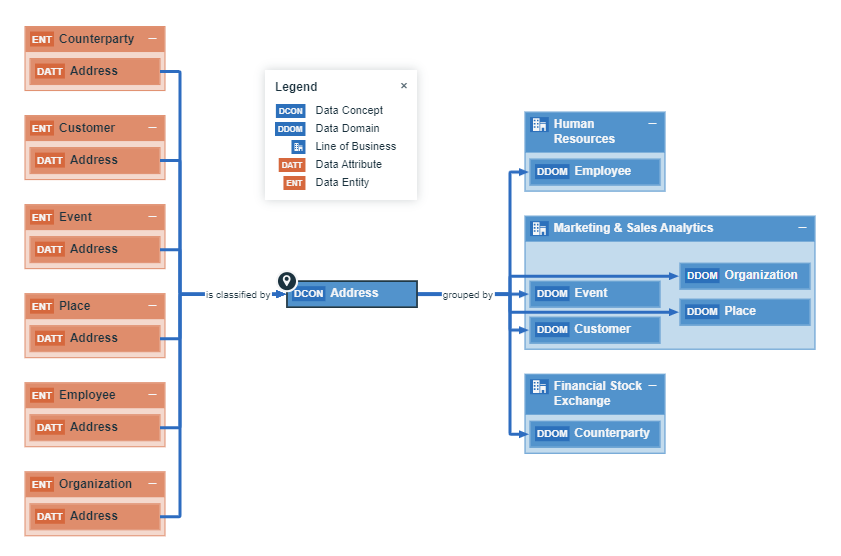
Data Concept assets are:
|
Related to... |
Via the relation type... |
Description |
|---|---|---|
| Data Domain assets | Business Asset groups / grouped by Business Asset |
Many-to-many relation, whereby:
|
|
Other Data Concept assets |
Business Asset groups / grouped by Business Asset |
Many-to-many relation, whereby:
|
| Data Attribute assets | Business Dimension classifies / is classified by Asset |
Many-to-one relation, whereby:
|
Related topics
About the Guided Stewardship model
About the semantic layer
About the physical layer