Example search queries and analysis
The following examples highlight common search text. We provide explanations for the results and explain how some configuration settings affect results.
- Help Collibra Data Intelligence Cloud administrators understand how the search configuration settings affect search results.
- Help other Collibra users understand why some search queries might not provide the expected results.
For more information, see the respective sections on customizing the search index, boosting, stop words and the exact match features.
Prerequisites
- An asset named "On The Go" exists in your Collibra environment.
Search text
Enter search text "On The Go".
Results
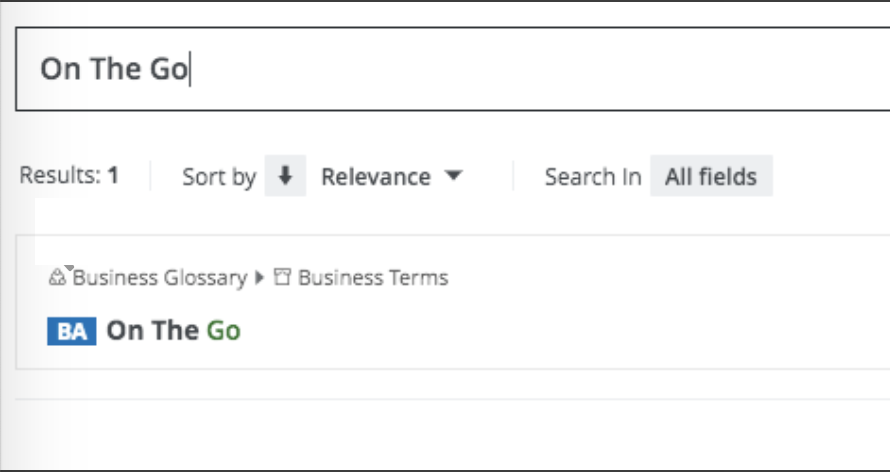
The asset "On The Go" is found.
In the following image, the word "Go" is shown in green text. This indicates that "Go" was the match that produced the result. The words "On The", which are shown in black text, did not produce a match.
Furthermore, if you enter search text "On The", the asset "On The Go" will not be found. Nor will any other asset. This is because "on" and "the" are stop words, which are filtered from indexing and searches.
Tip The best way to ensure thorough and intuitive search results is to name your assets, domains and communities as thoughtfully as possible.
Search text
Enter search text "marketing team summit".
The search engine handles the search text as: "marketing" OR "team" OR "summit*". Notice the wildcard (asterisk) at the end of the word "summit". This is determined by the default UI search appends wildcard setting, which adds the wildcard to the end of the search text.
Results
- An asset named "marketing_campaign_xyz" is not found.
- An asset named "team123' is not found.
- An asset named "summit_planning" is found.
To find the assets "marketing_campaign_xyz" and "team123", you have to add the wildcard after each word, for example: "marketing * team * summit". The search engine will handle this as: "marketing*" OR "team*" OR "summit*".
Prerequisites
- A resource, user or user group with the name "verylongname" exists in your Collibra environment.
- Edit resource type boost factors, in Collibra Console, as follows:
- Asset: 2
- Community: 4
- Domain: 6
- User: 8
- User group: 10
Search text
Enter search text "verylongname".
Results
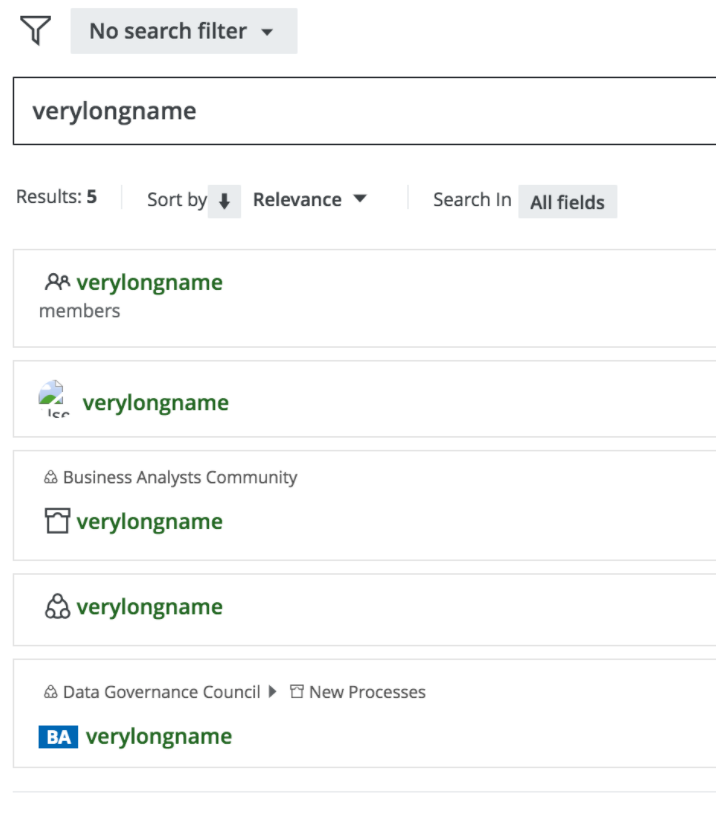
The results are ordered in accordance with the boost factor values of the respective resource types. Resource type user group, with a boost factor of 10, is the most relevant of the results. Asset, with a boost factor of 2, is the least relevant resource type.
Prerequisites
- The following assets exist in your Collibra environment:
- An asset named "superfeature".
- An asset named "asset1", with a tag "superfeature".
- An asset named "asset2", with a comment "superfeature"
- Edit property boost factors, in Collibra Settings, as follows:
- Name: 1
- Comment: 5
- Tag: 10
Search text
Enter search text "superfeature".
Results
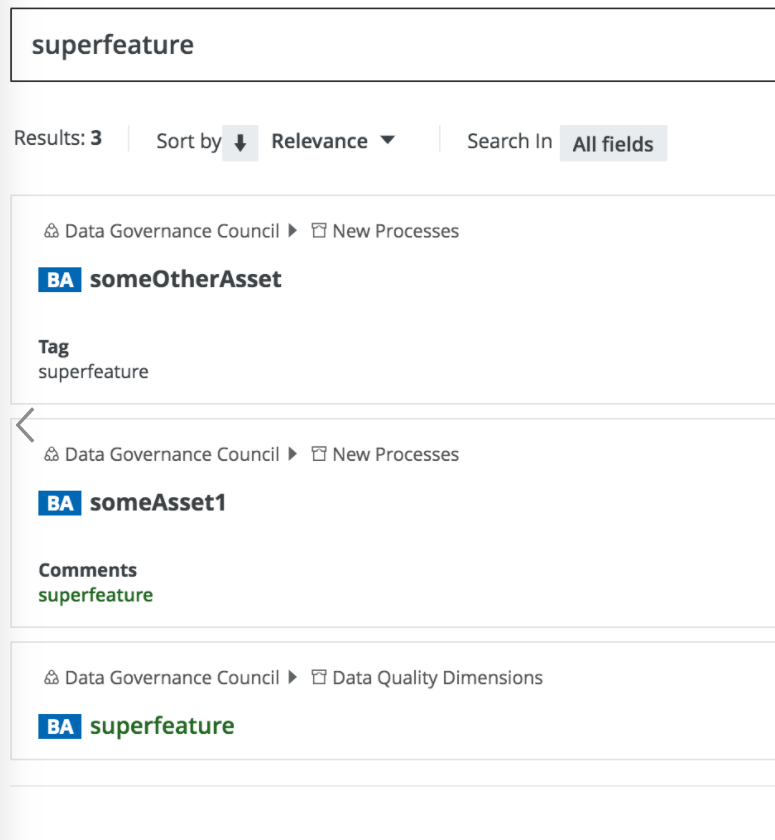
The results are ordered in accordance with the boost factor values of the respective fields. The tag field, with a boost factor of 10, is the most relevant of the results. Name, with a boost factor of 1, is the least relevant field.
Prerequisites
- The following assets exist in your Collibra environment:
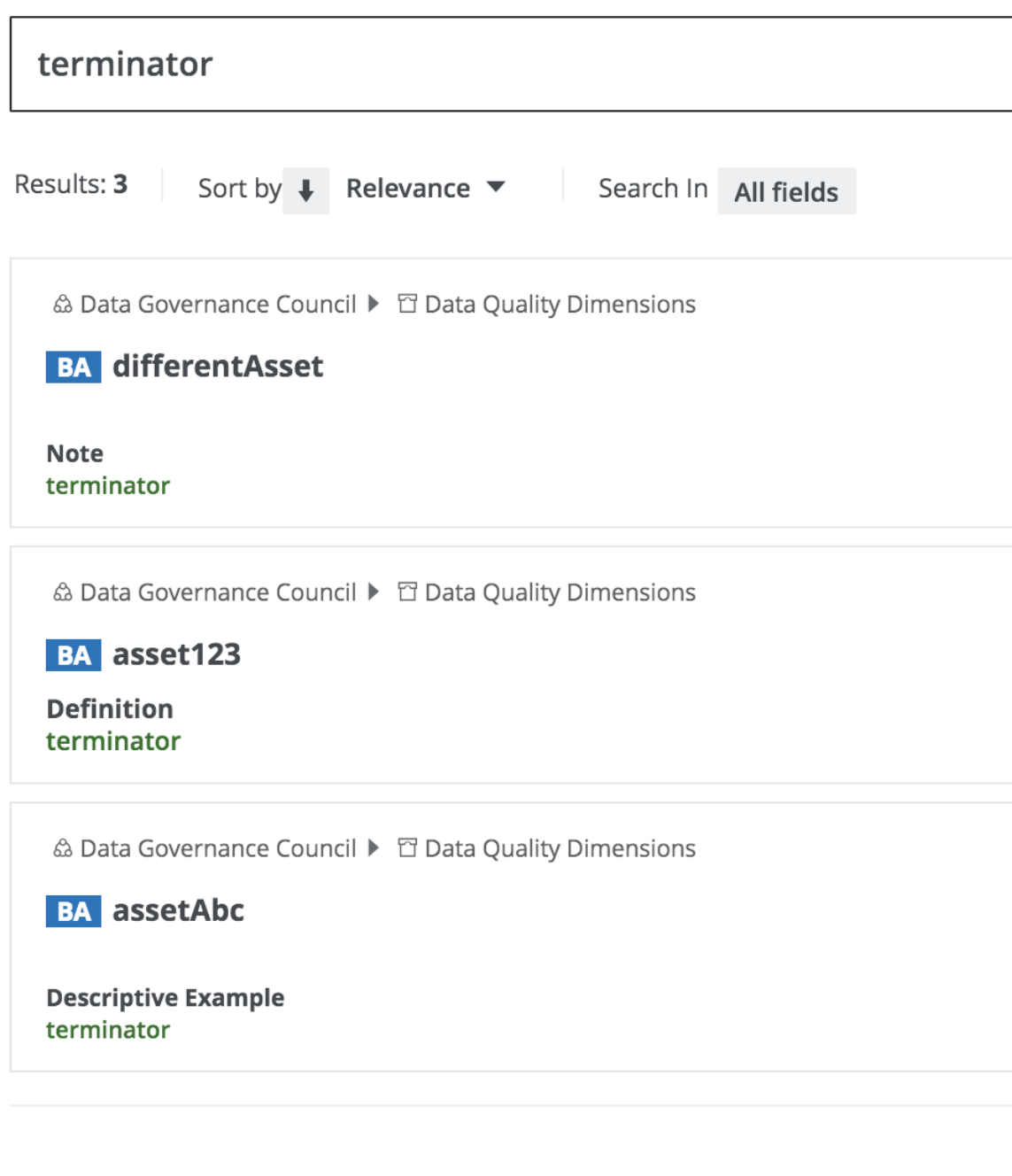
- An asset with the description "terminator".
- An asset with the definition "terminator".
- An asset with the note "definition".
- Edit attribute boost factors, in Collibra Console, as follows:
- Description: 1
- Definition: 2
- Note: 3
Search text
Enter search text "terminator".
Results
The results are ordered in accordance with the boost factor values of the respective attributes. The note attribute, with a boost factor of 3, is the most relevant of the results. Description, with a boost factor of 1, is the least relevant attribute.
Prerequisites
- The following assets exist in your Collibra environment:
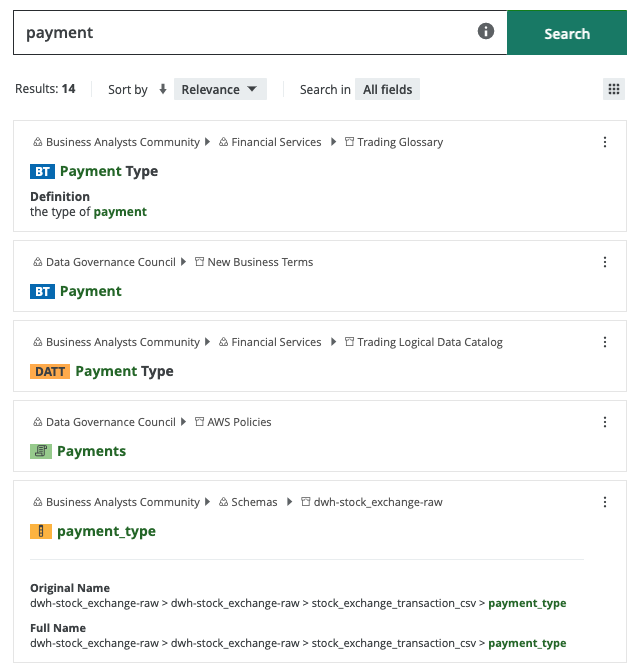
- A Business Term asset with the name "Payment".
- A Data Attribute asset with the name "Payment Type".
- A Policy asset with the name "Payments".
- Edit attribute boost factors, in Collibra Console, as follows:
- Business Term: 3
- Data Attribute: 2
- Policy: 1.5
Search text
Enter search text "payment".
Results
The results are ordered in accordance with the boost factor values of the respective asset types. The Business Term asset type, with a boost factor of 3, is the most relevant of the results. The Policy asset type, with a boost factor of 1.5, is the least relevant asset type of the three boosted asset types.
Prerequisites
- The following assets exist in your Collibra environment:
- A Schema asset with the name "Payment"
- A Business Term asset with the name "Payment Type".
- A Data Attribute asset with the name "Payment Type".
- A Policy asset with the name "Payments".
- Other assets, as shown in the following image.
- Edit asset type boost factors, in Collibra Console, as follows:
- Business Term: 3
- Data Attribute: 2
- Policy: 1.5
Search text
Enter search text "payment".
Results
The resources that exactly match the search text in the Name attribute of the resource appear first. In this example, there is only one exact match, the Schema asset with the name "Payment".
After the exact matches, the search results are sorted in order of descending relevance.

Prerequisites
- Several assets, each with a variation of "jedi" in the name, exist in your Collibra environment.
- Default boost factors for all resource types, properties and attributes.
Search text
Enter search text "jedi".
Results
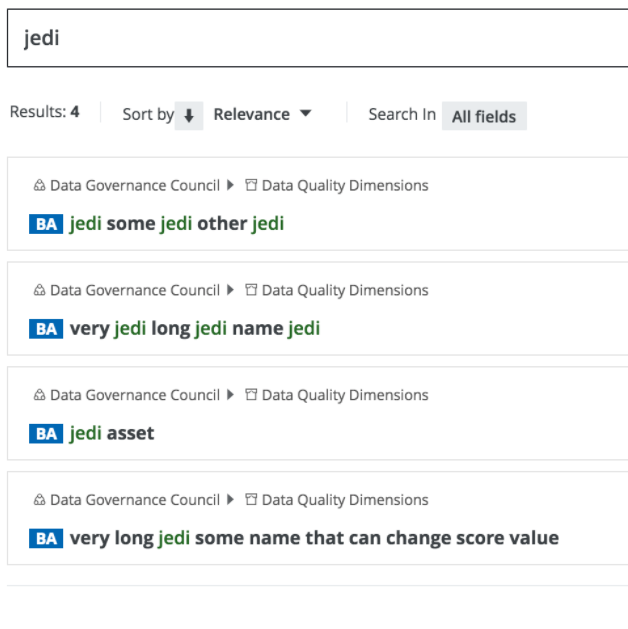
The results are ranked as shown in the following image. A combination of total number of matches in a name and the percentage of matches per total words in a name affect relevance scoring of the results.