Catalog asset pages
The asset pages in Data Catalog provide an overview of information related to an asset, based on its asset type's
Data Catalog experience
The Data Catalog asset pages have been tailored specifically to improve user experience of Data Catalog. The improvements include:
- Custom tabs corresponding to the page you are working on.
- Streamlined title bar showing general information.
- Quicker and easier navigation which requires less scrolling.
Data Catalog experience is enabled by default but you can
Tip Some features require you to enable Data Catalog experience. For example Collibra Data Lineage, Power BI and Looker.
Page layout
Click the icons to show information about the various Data Catalog asset pages.
|
Catalog experience |
Tab page |
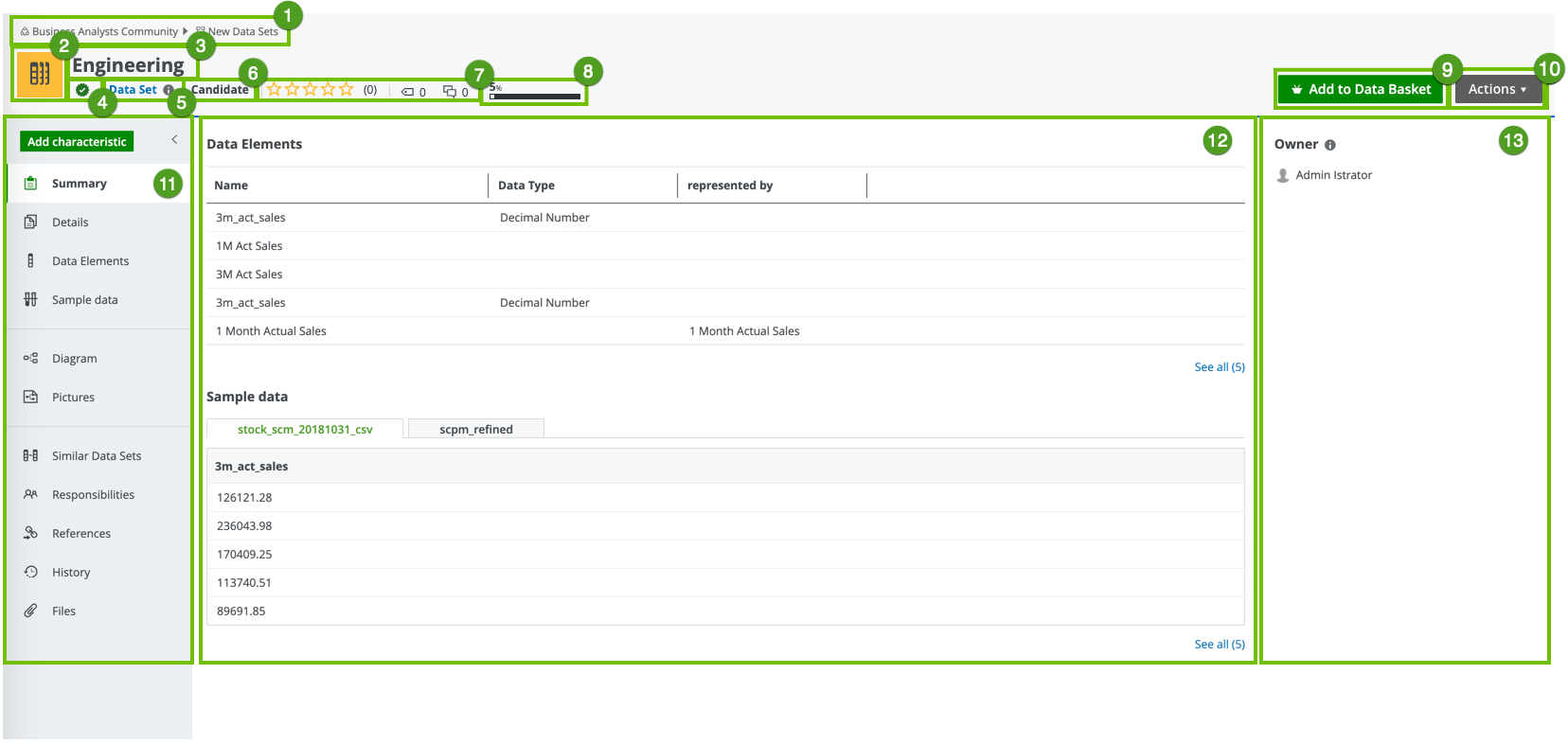
| Number | Section | Description |
|---|---|---|

|
Breadcrumbs |
The breadcrumbs of the current |

|
Asset type representation |
The icon or abbreviation of the Tip You can edit how an asset type is represented. |

|
Asset name |
The name of the |
|
|
Certification |
Indication whether the data set is certified or not. |
|
|
Asset type |
The name of the asset type, for example Schema or Data Set. |
|
|
Status |
The asset status, for example Approved. |
|
|
Collaborative features |
The collaborative features of assets, which consists of the following: |
|
|
Articulation score |
The articulation score of the asset. Note If there are no articulation score rules assigned to the asset, the asset page does not show an articulation score. |
|
|
Add to Data Basket |
Button to add the data set to a data basket. |
|
|
Actions menu |
Button to start workflows and perform other actions. |

|
Tab pane |
A collapsible pane that allows you to navigate to other pages of the |
|
Summary
|
The Summary tab page contains a read-only description of the asset, the related business assets
|
|
|
Details
|
The Details tab page contains information about the attributes from the Summary tab page and the attributes or relations that the user adds to the asset. It also contains tags and comments. |
|
|
Data elements
|
The
|
|
|
Sample data
|
The Sample data tab page shows the sample data of the related data elements |
|
|
|
Editor |
The currently selected page of the tab pane. Tip If you want to copy and paste text from other sources into a text field, we recommend that you click |
|
|
Preview |
The Preview panel offers a quick overview of the asset. The content depends on the asset's type. For example, it may contain the following fields:
|

 :
:  : Link to the
  :
Link to the
:
Link to the  , and then paste the text into the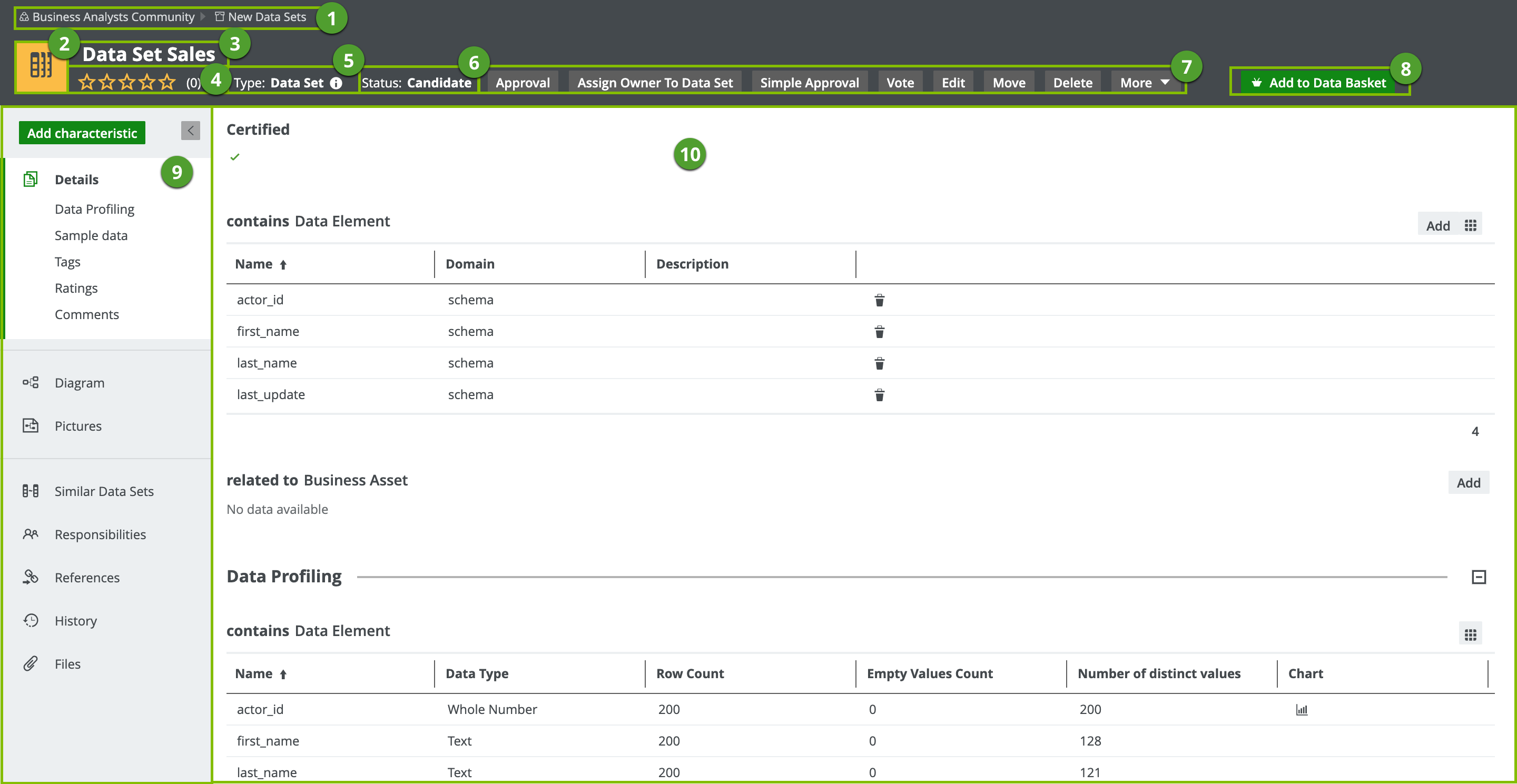
| Number | Section | Description |
|---|---|---|
|
|
Breadcrumbs |
The breadcrumbs of the current |
|
|
Asset type representation |
The icon or abbreviation of the Tip You can edit how an asset type is represented. |
|
|
Asset name |
The name of the |
|
|
Asset ratings |
The ratings of the asset. |
|
|
Asset type |
The name of the asset type, for example Schema or Data Set. |
|
|
Status |
The asset status, for example Approved. |
|
|
Resource toolbar |
Additional actions, such as editing the |
|
|
Add to Data Basket |
Button to add the data set to a data basket. |
|
|
Tab pane |
A collapsible pane that allows you to navigate to other pages of the |
|
Details
|
The Details tab page contains all the attributes, relations and complex relations that have been defined for the asset and whose type was added to the relevant assignment. If a certain attribute type has been assigned as mandatory for this asset type, this attribute is shown in the asset's Details tab page, even if no attribute value has been defined yet. |
|
|
Data Profiling
|
The section on the Details page containing the information about the data profiling of the Column, Table or Data Set. | |
|
Sample Data
|
The section on the Details page containing a number of lines of the Column or Data Set to give you an indication of its content. |
|
|
Tags
|
The section on the Details page containing the tags that were assigned to this asset. |
|
|
Ratings
|
The section on the Details page containing the ratings of the asset. |
|
|
Comments
|
The section on the Details page containing the comments of users. |
|

|
Editor |
The currently selected page of the tab pane. Tip If you want to copy and paste text from other sources into a text field, we recommend that you click Tip If the technical data type of the asset is a structural data type, for example Struct or Array, you can use the ActionsMore menu to show the value in a technical data tree in a separate dialog box.
 |
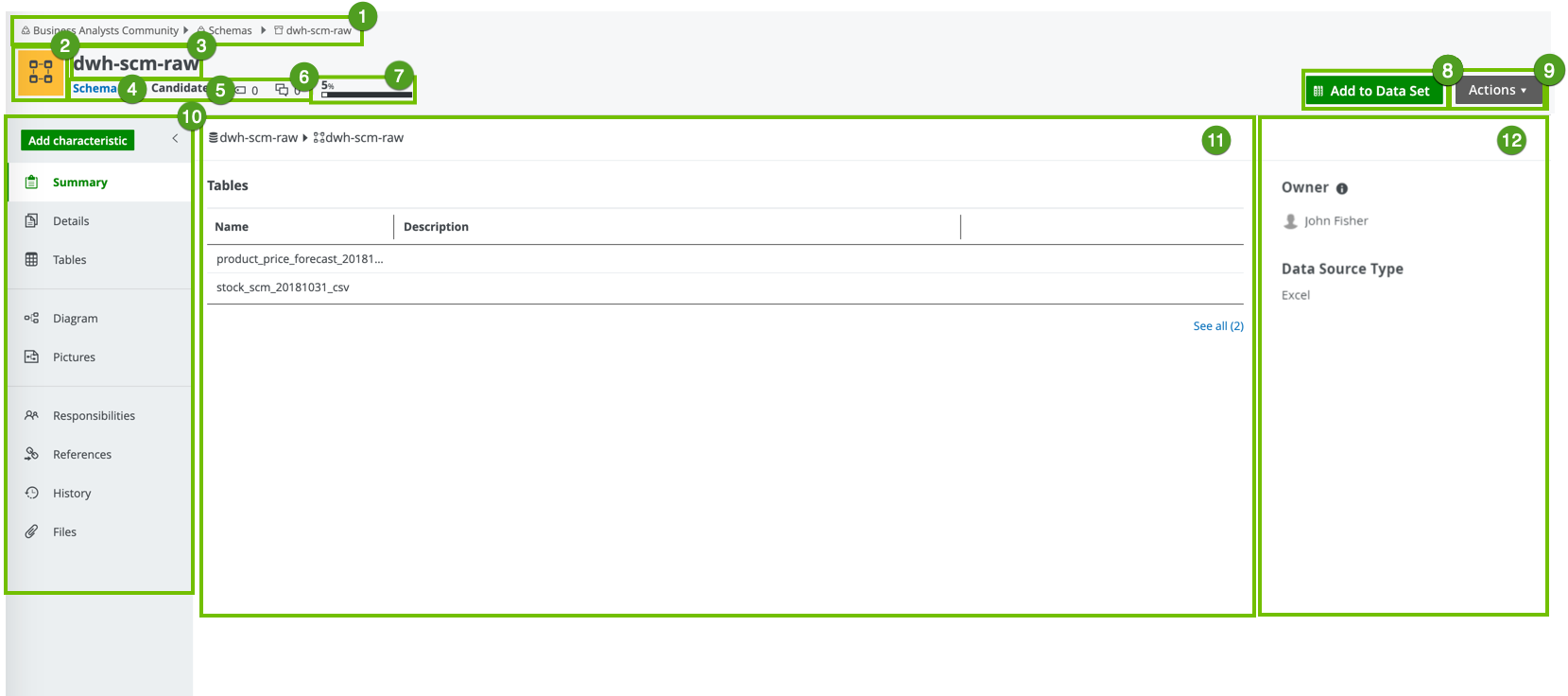
| Number | Section | Description |
|---|---|---|
|
|
Breadcrumbs |
The breadcrumbs of the current |
|
|
Asset type representation |
The icon or abbreviation of the Tip You can edit how an asset type is represented. |
|
|
Asset name |
The name of the |
|
|
Asset type |
The name of the asset type, for example Schema or Data Set. |
|
|
Status |
The asset status, for example Approved. |
|
|
Collaborative features |
The collaborative features of assets, which consists of the following: |
|
|
Articulation score |
The articulation score of the asset. Note If there are no articulation score rules assigned to the asset, the asset page does not show an articulation score. |
|
|
Add to Data Set |
|
|
|
Actions menu |
Button to start workflows and perform other actions. |
|
|
Tab pane |
A collapsible pane that allows you to navigate to other pages of the |
|
Summary
|
The Summary tab page contains a read-only description of the asset, the related business assets
and
|
|
|
Details
|
The Details tab page contains information about the attributes from the Summary tab page and the attributes or relations that the user adds to the asset. It also contains tags and comments. |
|
|
Tables
|
The
|
|
|
|
Editor |
The currently selected page of the tab pane. Tip If you want to copy and paste text from other sources into a text field, we recommend that you click |
|
|
Preview |
The Preview panel offers a quick overview of the asset. The content depends on the asset's type. For example, it may contain the following fields:
|
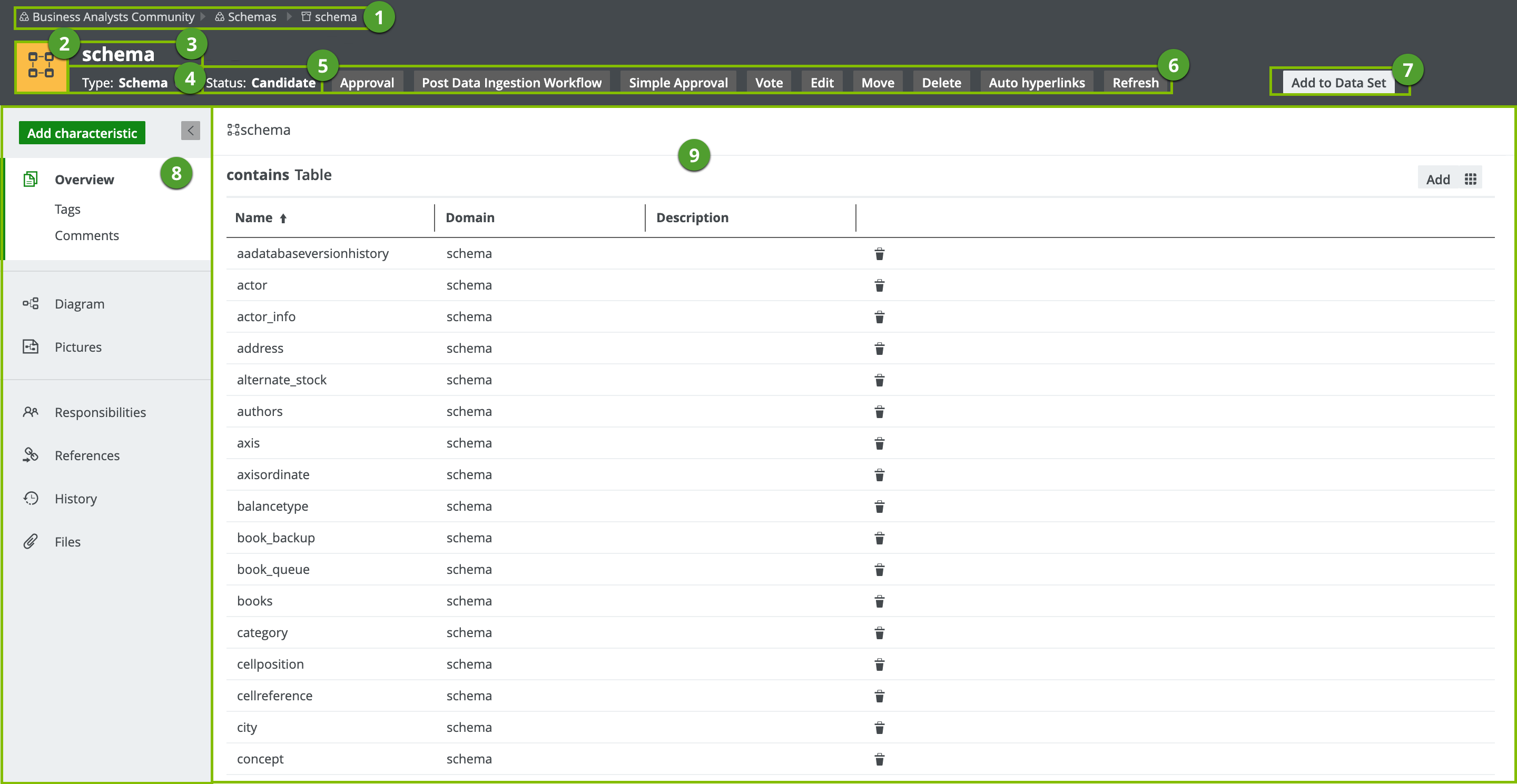
| Number | Section | Description |
|---|---|---|
|
|
Breadcrumbs |
The breadcrumbs of the current |
|
|
Asset type representation |
The icon or abbreviation of the Tip You can edit how an asset type is represented. |
|
|
Asset name |
The name of the |

|
Asset type |
The name of the asset type, for example Schema or Data Set. |

|
Status |
The asset status, for example Approved. |

|
Resource toolbar |
Additional actions, such as editing the |
|
|
Add to Data Set |
|
|
|
Tab pane |
A collapsible pane that allows you to navigate to other pages of the |
|
Overview
|
The Overview tab page contains all the attributes, relations and complex relations that have been defined for the asset and whose type was added to the relevant assignment. If a certain attribute type has been assigned as mandatory for this asset type, this attribute is shown in the asset's Overview tab, even if no attribute value has been defined yet. |
|
|
Tags
|
The section on the Details page containing the tags that were assigned to this asset. |
|
|
Comments
|
The section on the Details page containing the comments of users. |
|

|
Editor |
The currently selected page of the tab pane. Tip If you want to copy and paste text from other sources into a text field, we recommend that you click Tip If the technical data type of the asset is a structural data type, for example Struct or Array, you can use the ActionsMore menu to show the value in a technical data tree in a separate dialog box.
|
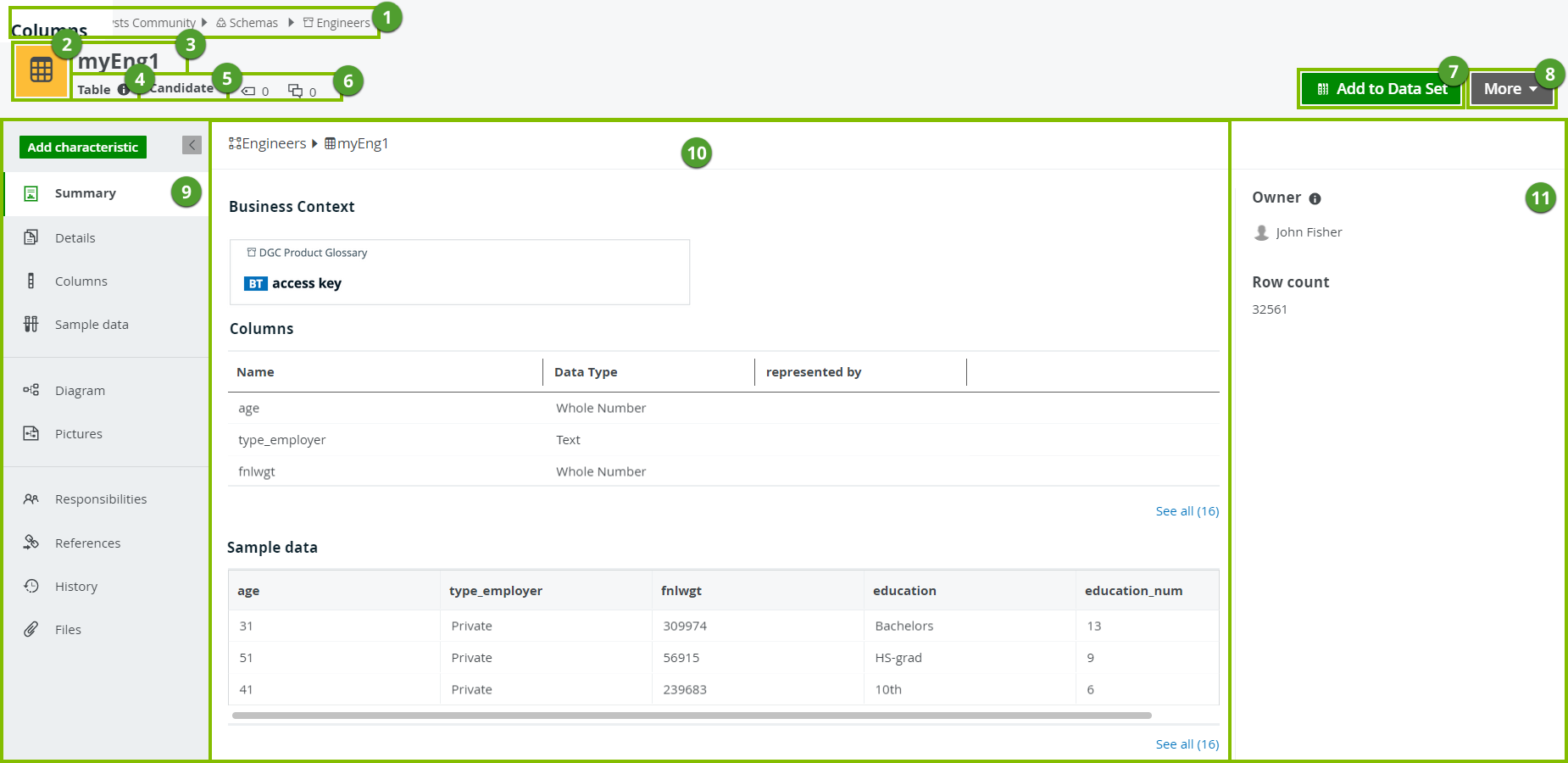
| Number | Section | Description |
|---|---|---|
|
|
Breadcrumbs |
The breadcrumbs of the current |
|
|
Asset type representation |
The icon or abbreviation of the Tip You can edit how an asset type is represented. |
|
|
Asset name |
The name of the |
|
|
Asset type |
The name of the asset type, for example Schema or Data Set. |
|
|
Status |
The asset status, for example Approved. |
|
|
Collaborative features |
The collaborative features of assets, which consists of the following: |
|
|
Articulation score |
The articulation score of the asset. Note If there are no articulation score rules assigned to the asset, the asset page does not show an articulation score. |
|
|
Validation result |
The result of all validation rules assigned to the asset.
You can click the validation result and then Revalidate to execute the validation rules again. Note If there are no validation rules assigned to the asset, the asset page does not show any validation results. |
|
|
Add to Data Set |
Button to add the asset to a data set. |
|
|
Actions menu |
Button to start workflows and perform other actions. |
|
|
Tab pane |
A collapsible pane that allows you to navigate to other pages of the |
|
Summary
|
The Summary tab page contains a read-only description of the asset, the related business assets
|
|
|
Details
|
The Details tab page contains information about the attributes from the Summary tab page and the attributes or relations that the user adds to the asset. It also contains tags and comments. |
|
|
Columns
|
The
|
|
|
Sample data
|
The Sample data tab page shows the sample data of the related data elements |
|
|
|
Editor |
The currently selected page of the tab pane. Tip If you want to copy and paste text from other sources into a text field, we recommend that you click |
|
|
Preview |
The Preview panel offers a quick overview of the asset. The content depends on the asset's type. For example, it may contain the following fields:
|
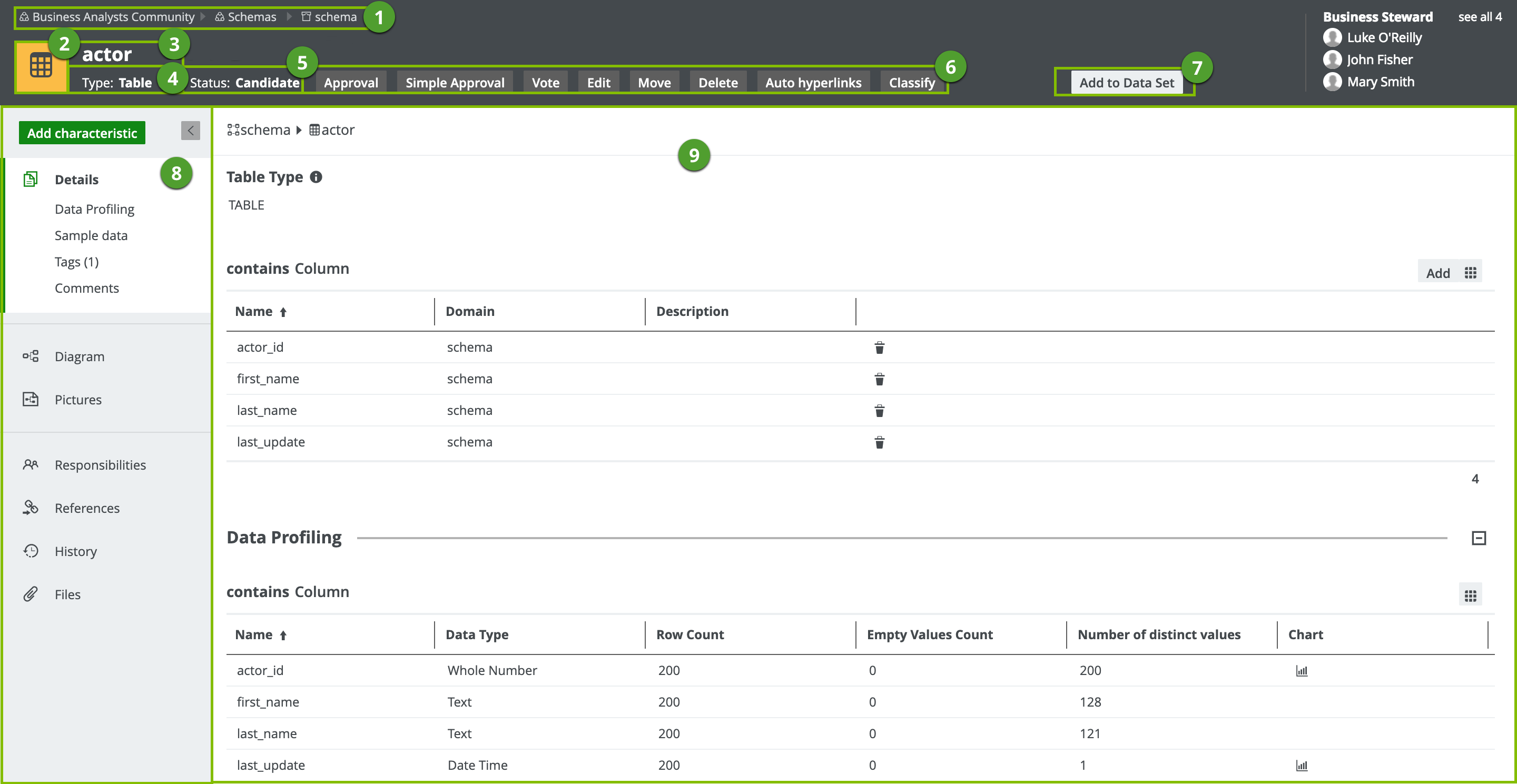
| Number | Section | Description |
|---|---|---|
|
|
Breadcrumbs |
The breadcrumbs of the current |
|
|
Asset type representation |
The icon or abbreviation of the Tip You can edit how an asset type is represented. |
|
|
Asset name |
The name of the |
|
|
Asset type |
The name of the asset type, for example Schema or Data Set. |
|
|
Status |
The asset status, for example Approved. |
|
|
Resource toolbar |
Additional actions, such as editing the |
|
|
Add to Data Set |
|
|
|
Tab pane |
A collapsible pane that allows you to navigate to other pages of the |
|
Details
|
The Details tab page contains all the attributes, relations and complex relations that have been defined for the asset and whose type was added to the relevant assignment. If a certain attribute type has been assigned as mandatory for this asset type, this attribute is shown in the asset's Details tab page, even if no attribute value has been defined yet. |
|
|
Data Profiling
|
The section on the Details page containing the information about the data profiling of the Column, Table or Data Set. | |
|
Sample Data
|
The section on the Details page containing a number of lines of the Column or Data Set to give you an indication of its content. |
|
|
Tags
|
The section on the Details page containing the tags that were assigned to this asset. |
|
|
Comments
|
The section on the Details page containing the comments of users. |
|
|
|
Editor |
The currently selected page of the tab pane. Tip If you want to copy and paste text from other sources into a text field, we recommend that you click Tip If the technical data type of the asset is a structural data type, for example Struct or Array, you can use the ActionsMore menu to show the value in a technical data tree in a separate dialog box.
|
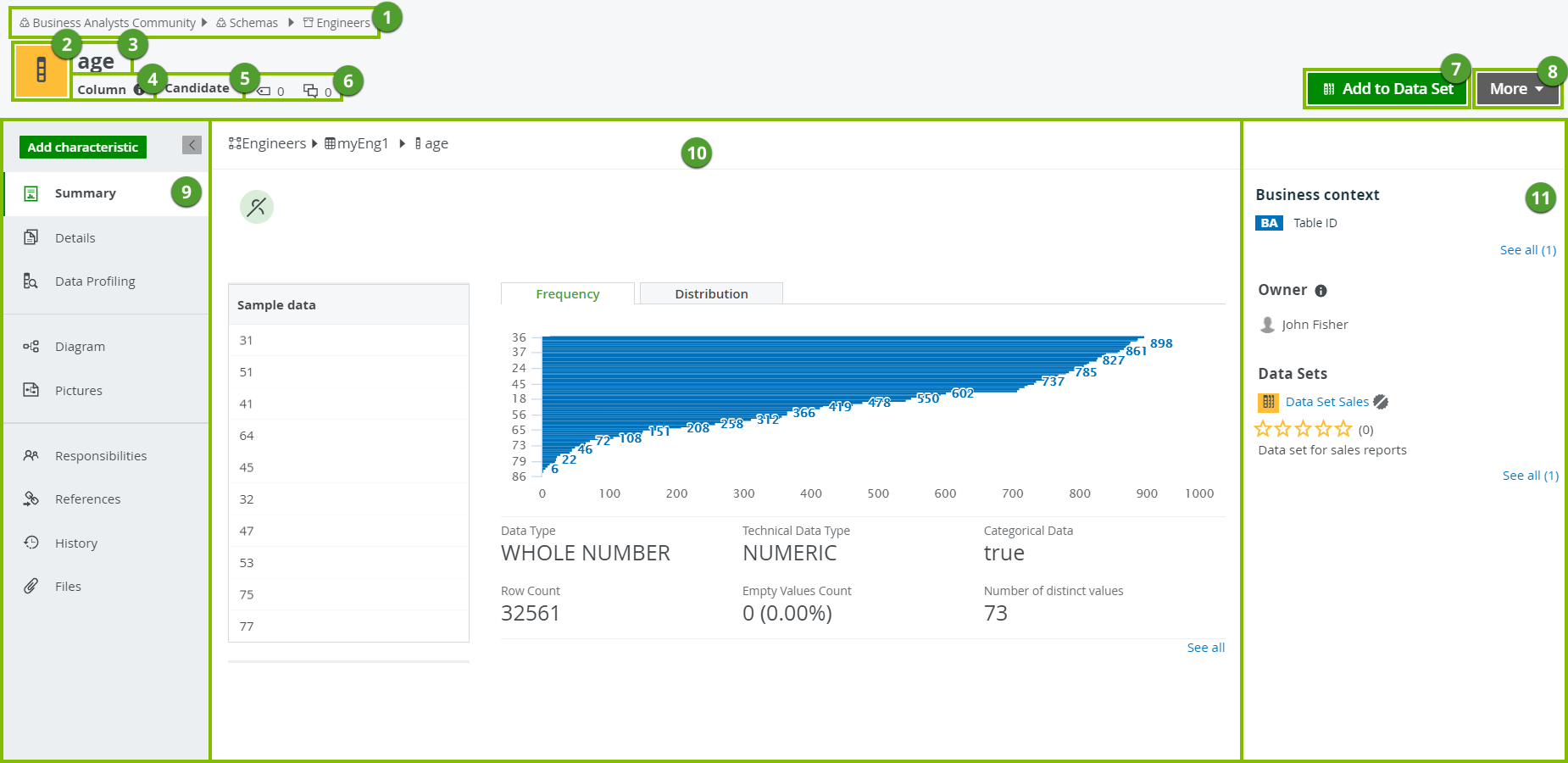
| Number | Section | Description |
|---|---|---|
|
|
Breadcrumbs |
The breadcrumbs of the current |
|
|
Asset type representation |
The icon or abbreviation of the Tip You can edit how an asset type is represented. |
|
|
Asset name |
The name of the |
|
|
Asset type |
The name of the asset type, for example Schema or Data Set. |
|
|
Status |
The asset status, for example Approved. |
|
|
Collaborative features |
The collaborative features of assets, which consists of the following: |
|
|
Articulation score |
The articulation score of the asset. Note If there are no articulation score rules assigned to the asset, the asset page does not show an articulation score. |
|
|
Validation result |
The result of all validation rules assigned to the asset.
You can click the validation result and then Revalidate to execute the validation rules again. Note If there are no validation rules assigned to the asset, the asset page does not show any validation results. |
|
|
Add to Data Set |
Button to add the asset to a data set. |
|
|
Actions menu |
Button to start workflows and perform other actions. |
|
|
Tab pane |
A collapsible pane that allows you to navigate to other pages of the |
|
Summary
|
The Summary tab page contains a short, read-only overview with some sample data. Tip You can also quickly see whether the column contains personal information |
|
|
Details
|
The Details tab page contains information about the attributes or relations of the asset. It also contains tags and comments. |
|
|
Data profiling
|
The Data profiling tab page contains the data classification of the column, and statistics and graphics to give the user a first idea what the registered data is about. |
|
|
|
Editor |
The currently selected page of the tab pane. Tip If you want to copy and paste text from other sources into a text field, we recommend that you click Tip If the technical data type of the asset is a structural data type, for example Struct or Array, you can use the ActionsMore menu to show the value in a technical data tree in a separate dialog box.
|
|
|
Preview |
The Preview panel offers a quick overview of the asset. The content depends on the asset's type. For example, it may contain the following fields:
|
 or not
  .
.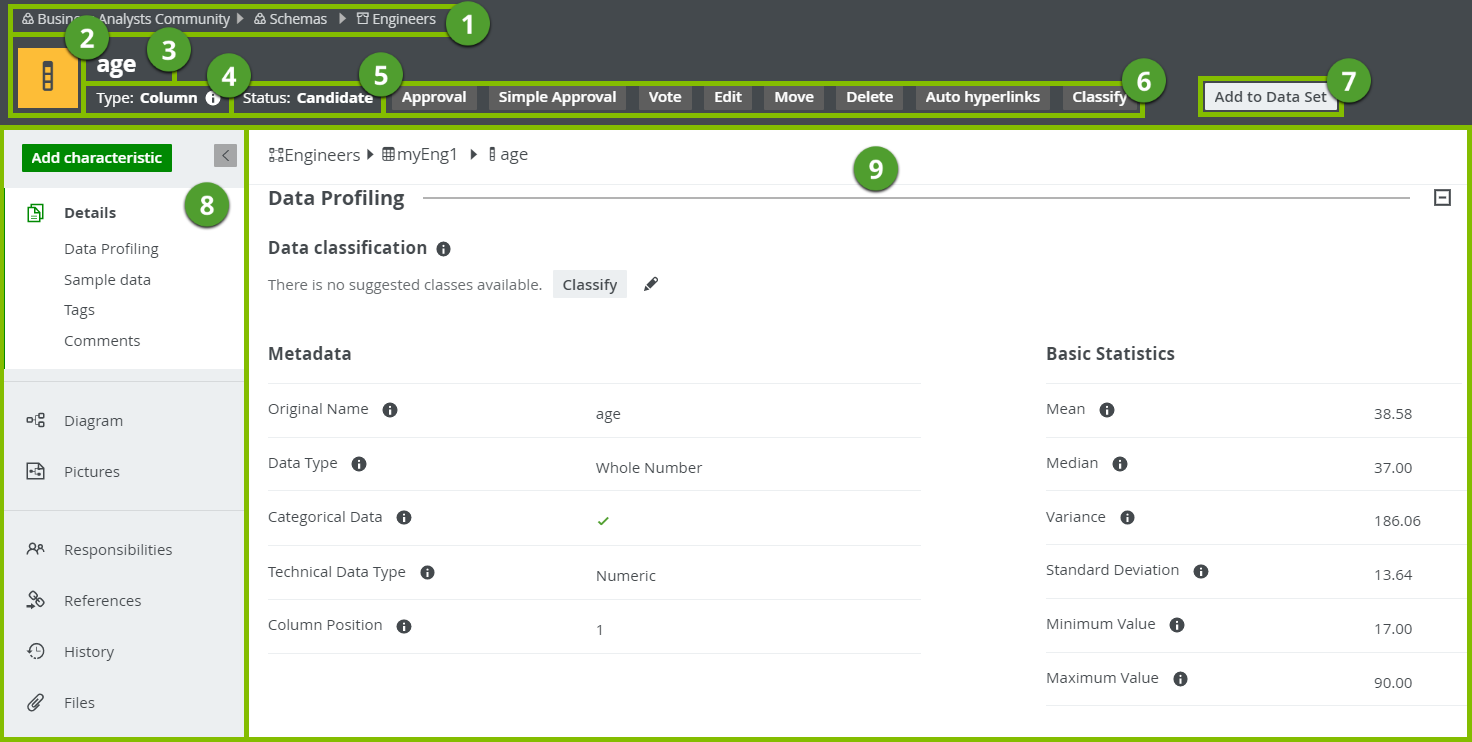
| Number | Section | Description |
|---|---|---|
|
|
Breadcrumbs |
The breadcrumbs of the current |
|
|
Asset type representation |
The icon or abbreviation of the Tip You can edit how an asset type is represented. |
|
|
Asset name |
The name of the |
|
|
Asset type |
The name of the asset type, for example Schema or Data Set. |
|
|
Status |
The asset status, for example Approved. |
|
|
Resource toolbar |
Additional actions, such as editing the |
|
|
Add to Data Set |
|
|
|
Tab pane |
A collapsible pane that allows you to navigate to other pages of the |
|
Details
|
The Details tab page contains all the attributes, relations and complex relations that have been defined for the asset and whose type was added to the relevant assignment. If a certain attribute type has been assigned as mandatory for this asset type, this attribute is shown in the asset's Details tab page, even if no attribute value has been defined yet. |
|
|
Data Profiling
|
The section on the Details page containing the information about the data profiling of the Column, Table or Data Set. | |
|
Sample Data
|
The section on the Details page containing a number of lines of the Column or Data Set to give you an indication of its content. |
|
|
Tags
|
The section on the Details page containing the tags that were assigned to this asset. |
|
|
Comments
|
The section on the Details page containing the comments of users. |
|
|
|
Editor |
The currently selected page of the tab pane. Tip If you want to copy and paste text from other sources into a text field, we recommend that you click Tip If the technical data type of the asset is a structural data type, for example Struct or Array, you can use the ActionsMore menu to show the value in a technical data tree in a separate dialog box.
|
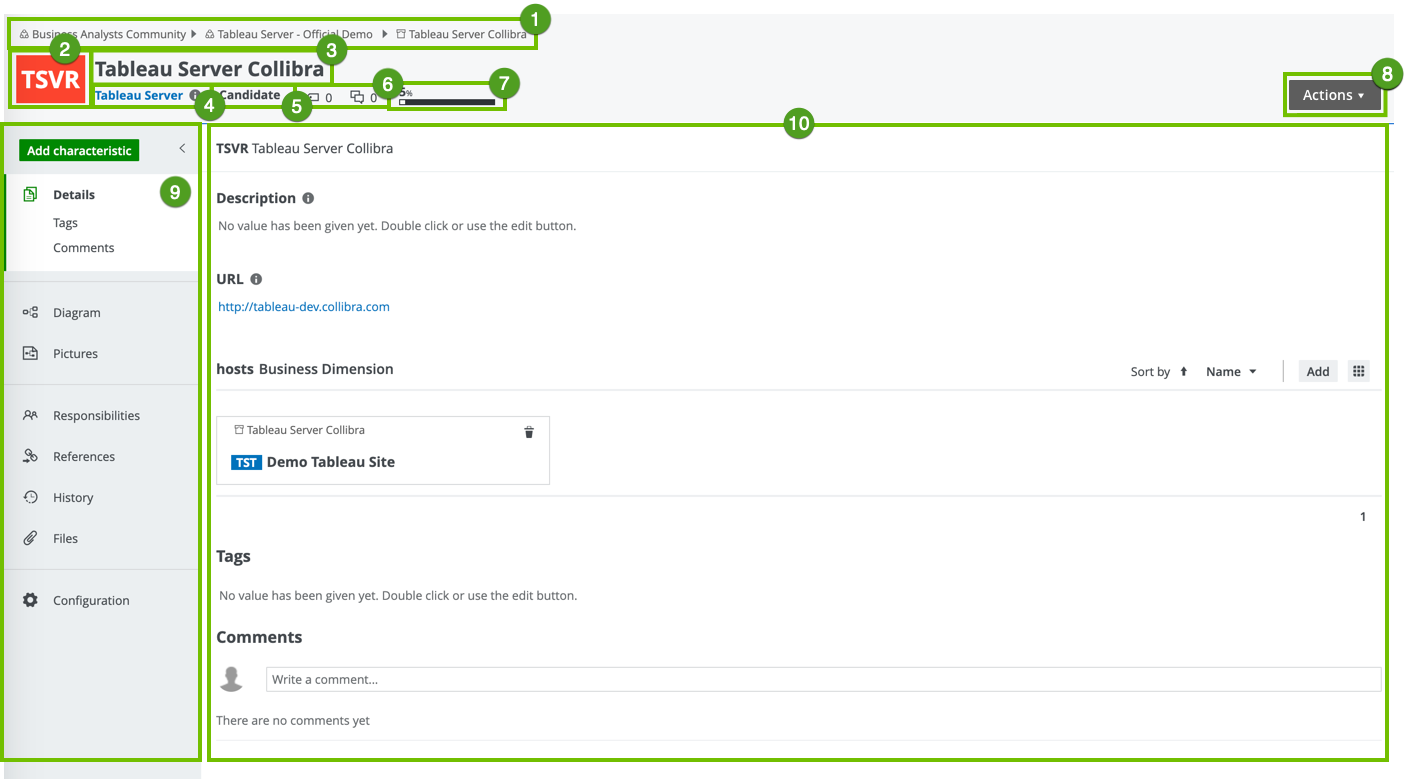
| Number | Section | Description |
|---|---|---|
|
|
Breadcrumbs |
The breadcrumbs of the current |
|
|
Asset type representation |
The icon or abbreviation of the Tip You can edit how an asset type is represented. |
|
|
Asset name |
The name of the |
|
|
Asset type |
The name of the asset type, for example Schema or Data Set. |
|
|
Status |
The asset status, for example Approved. |
|
|
Collaborative features |
The collaborative features of assets, which consists of the following: |
|
|
Articulation score |
The articulation score of the asset.If there are no articulation score rules assigned to the asset, the asset page does not show an articulation score. |
|
|
Actions menu |
Button to start workflows and perform other actions. |
|
|
Tab pane |
A collapsible pane that allows you to navigate to other pages of the |
|
|
Editor |
The currently selected page, in this case the Details tab page, which contains information about the attributes or relations that the user adds to the asset. It also contains tags and comments. |
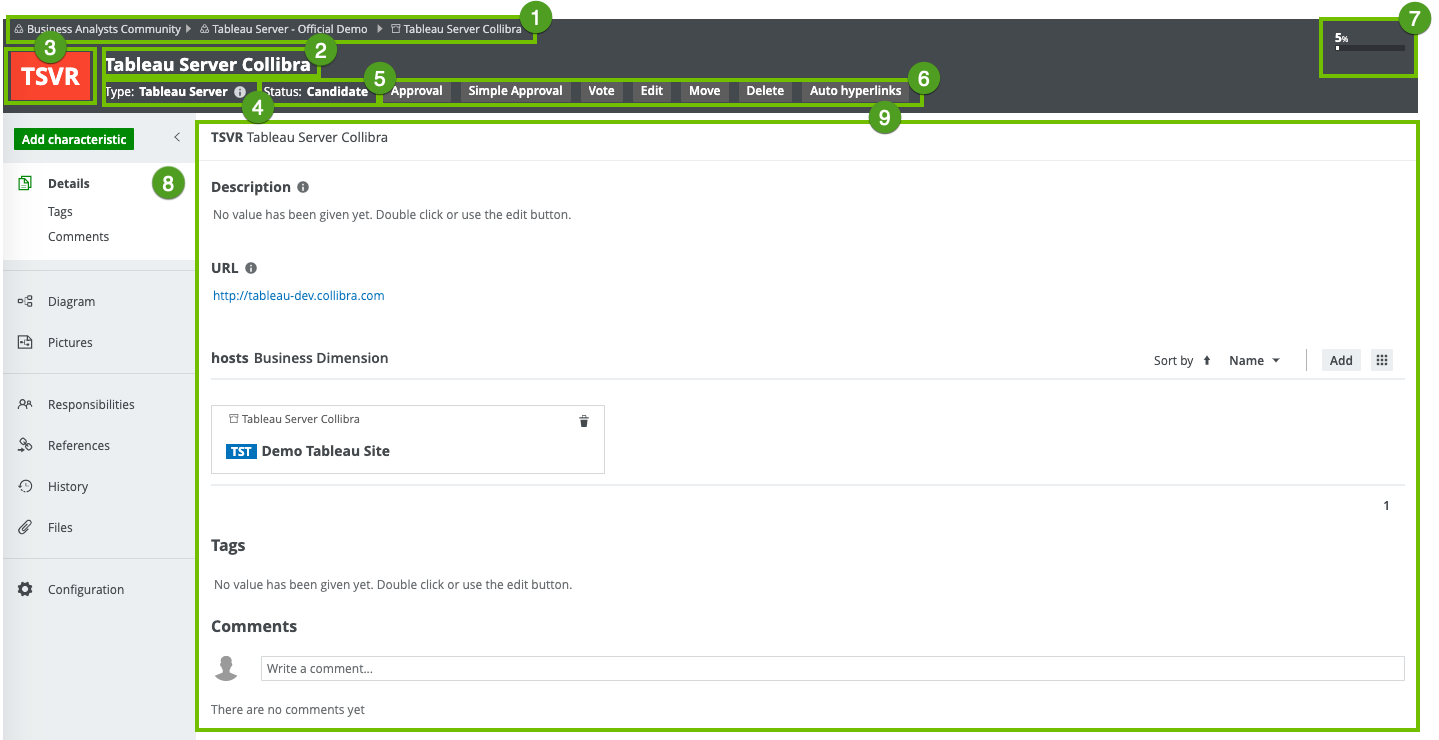
| Number | Section | Description |
|---|---|---|
|
|
Breadcrumbs |
The breadcrumbs of the current |
|
|
Asset type representation |
The icon or abbreviation of the Tip You can edit how an asset type is represented. |
|
|
Asset name |
The name of the |
|
|
Asset type |
The name of the asset type, for example Schema or Data Set. |
|
|
Status |
The asset status, for example Approved. |
|
|
Resource toolbar | Additional actions, such as editing the |
|
|
Articulation score |
The articulation score of the asset.If there are no articulation score rules assigned to the asset, the asset page does not show an articulation score. |

|
Tab pane |
A collapsible pane that allows you to navigate to other pages of the |
|
|
Editor |
The currently selected page, in this case the Details tab page, which contains information about the attributes or relations that the user adds to the asset. It also contains tags and comments. |
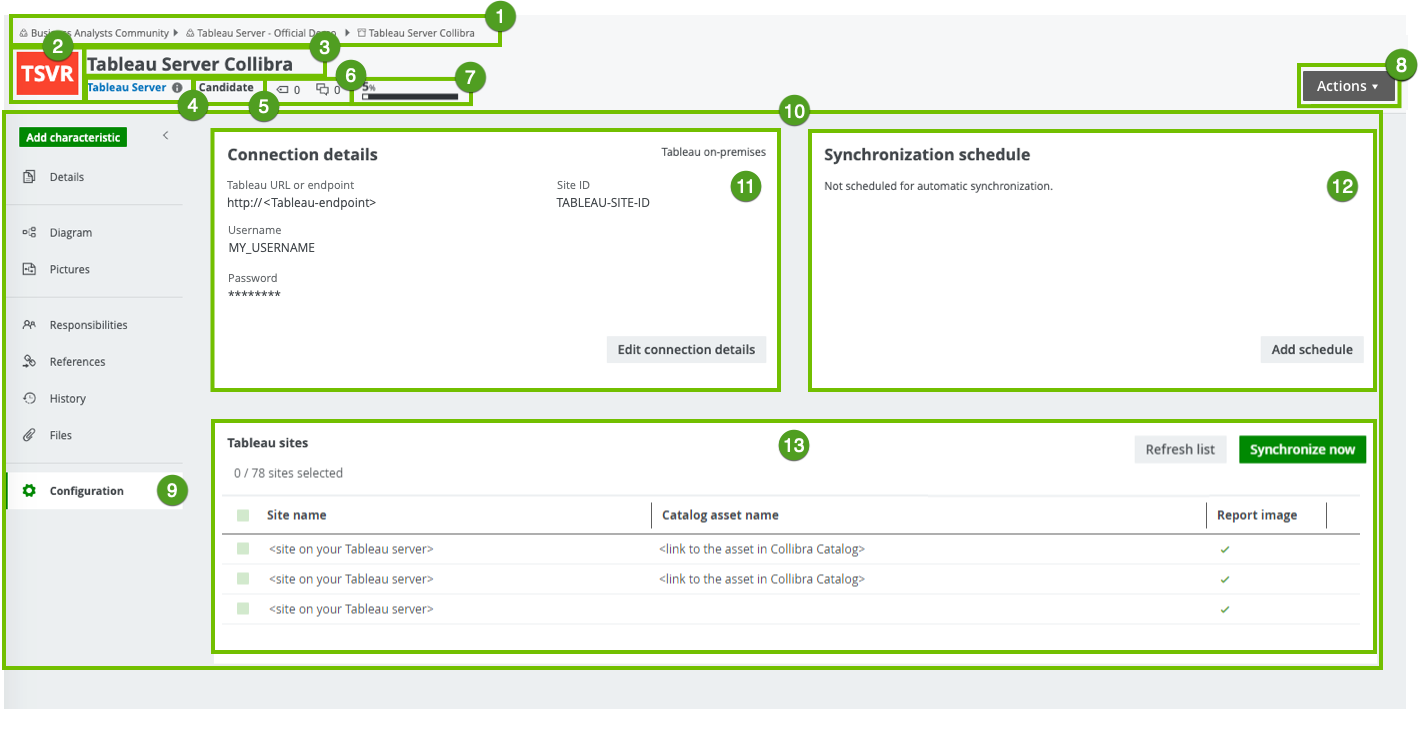
| Number | Section | Description |
|---|---|---|
|
|
Breadcrumbs |
The breadcrumbs of the current |
|
|
Asset type representation |
The icon or abbreviation of the Tip You can edit how an asset type is represented. |
|
|
Asset name |
The name of the |
|
|
Asset type |
The name of the asset type, for example Schema or Data Set. |
|
|
Status |
The asset status, for example Approved. |
|
|
Collaborative features |
The collaborative features of assets, which consists of the following: |
|
|
Articulation score |
The articulation score of the asset.If there are no articulation score rules assigned to the asset, the asset page does not show an articulation score. |
|
|
Actions menu |
Button to start workflows and perform other actions. |
|
|
Tab pane |
A collapsible pane that allows you to navigate to other pages of the |
|
|
Editor |
The currently selected page, in this case the Configuration page, which contains the Connection details section, the Synchronization section and Tableau sites found on server section of the Tableau Server asset. |
|
|
Connection details
|
The connection details to Tableau and a button to edit them. |

|
Synchronization
|
A basic explanation about the synchronization schedule and the buttons to add, edit and remove a schedule. |

|
Tableau sites
|
The list of sites on the Tableau server, as well as buttons to show the sites and to synchronize manually. |
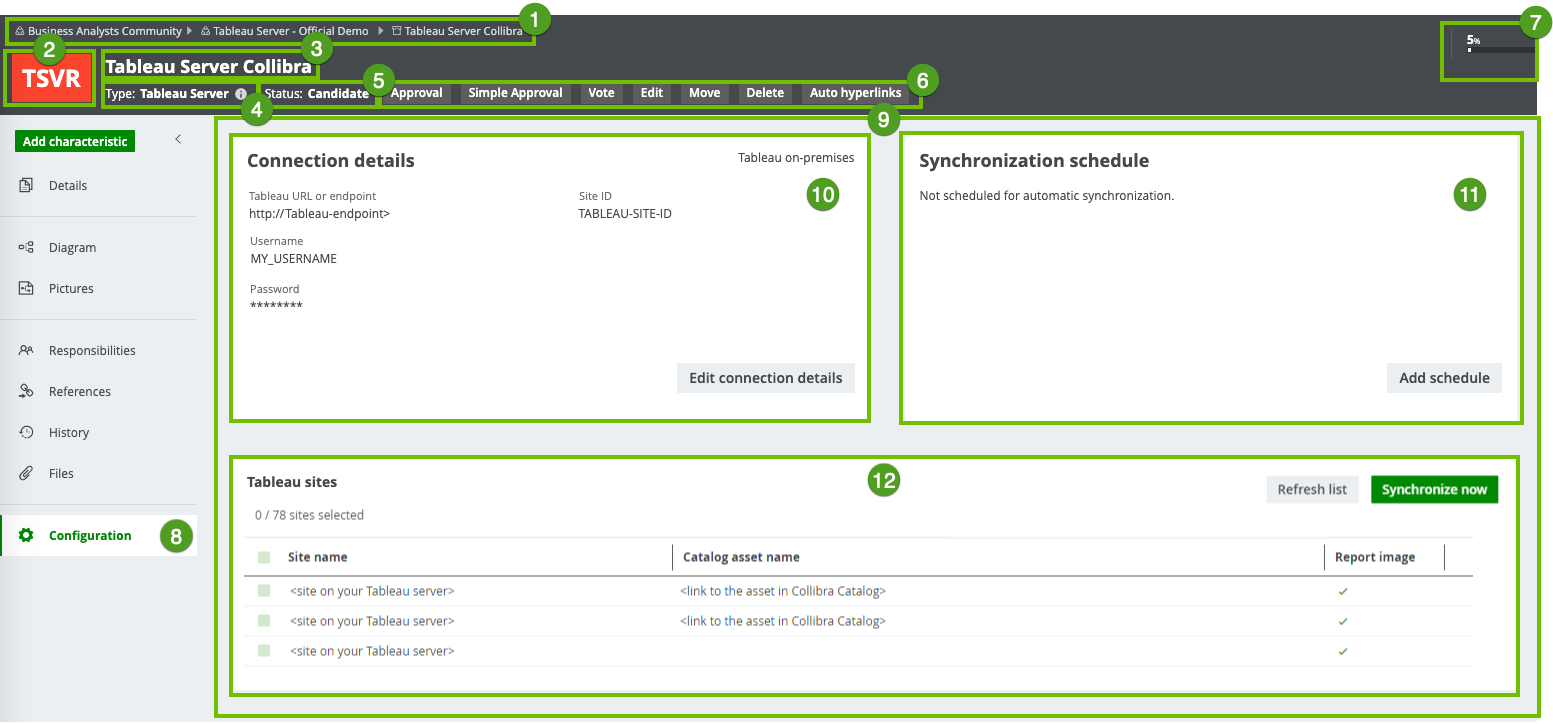
| Number | Section | Description |
|---|---|---|
|
|
Breadcrumbs |
The breadcrumbs of the current |
|
|
Asset type representation |
The icon or abbreviation of the Tip You can edit how an asset type is represented. |
|
|
Asset name |
The name of the |
|
|
Asset type |
The name of the asset type, for example Schema or Data Set. |
|
|
Status |
The asset status, for example Approved. |
|
|
Resource toolbar | Additional actions, such as editing the |
|
|
Articulation score |
The articulation score of the asset. Note If there are no articulation score rules assigned to the asset, the asset page does not show an articulation score. |
|
|
Tab pane |
A collapsible pane that allows you to navigate to other pages of the |
|
|
Editor |
The currently selected page, in this case the Configuration page, which contains the Connection details section, the Synchronization section and Tableau sites found on server section of the Tableau Server asset. |
|
|
Connection details
|
The connection details to Tableau and a button to edit them. |
|
|
Synchronization
|
A basic explanation about the synchronization schedule and the buttons to add, edit and remove a schedule. |
|
|
Tableau sites
|
The list of sites on the Tableau server, as well as buttons to show the sites and to synchronize manually. |
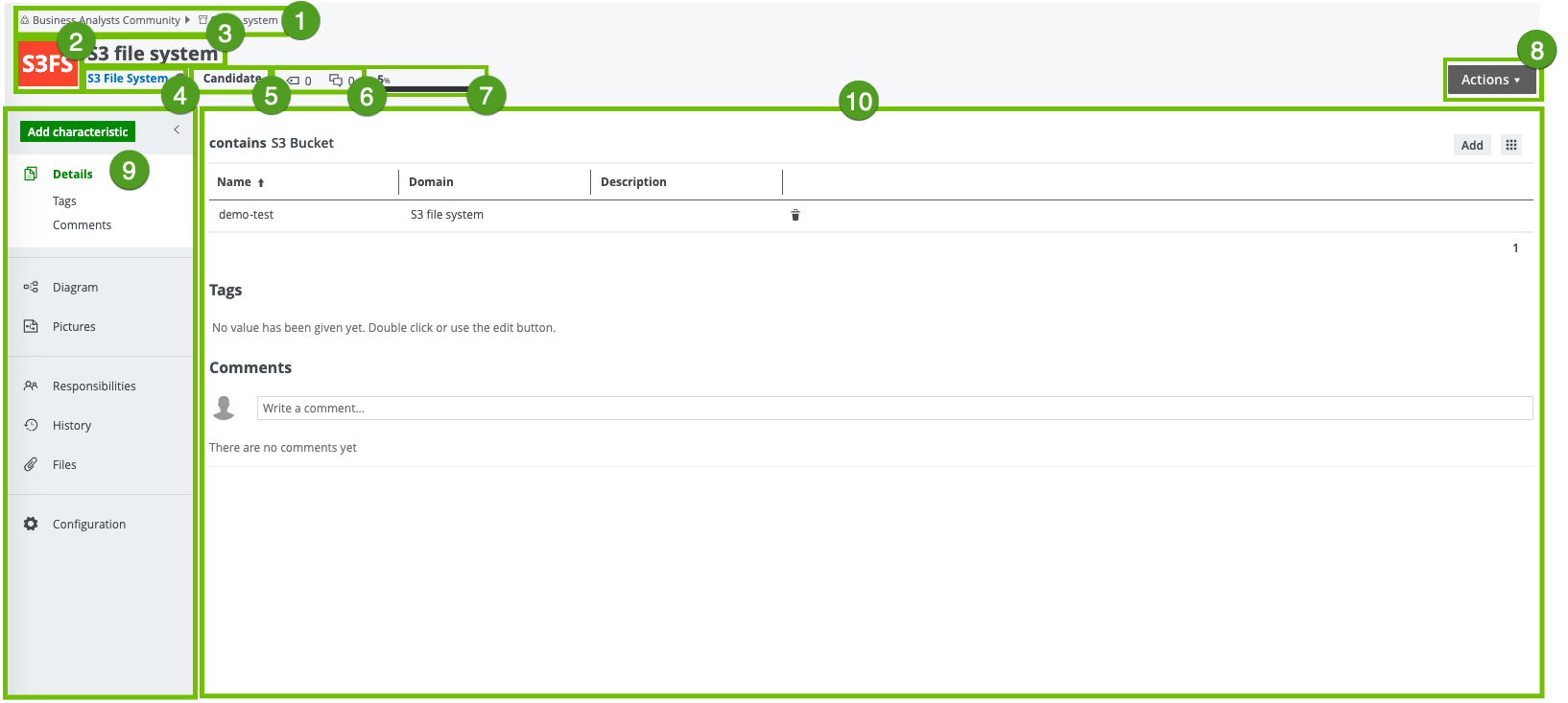
| Number | Section | Description |
|---|---|---|
|
|
Breadcrumbs | The breadcrumbs of the current |
|
|
Asset type representation |
The icon or abbreviation of the Tip You can edit how an asset type is represented. |
|
|
Asset name | The name of the |
|
|
Asset type |
The name of the asset type, for example S3 File System. |
|
|
Status |
The asset status, for example Approved. |
|
|
Collaborative features |
The collaborative features of assets, which consists of the following: |
|
|
Articulation score |
The articulation score of the asset.If there are no articulation score rules assigned to the asset, the asset page does not show an articulation score. |
|
|
Actions menu |
Menu containing specific actions such as starting a workflow. |
|
|
Tab pane |
A collapsible pane that allows you to navigate to other pages of the |
|
|
Editor |
The currently selected page, in this case the Details page, which contains all the attributes If a certain attribute type has been assigned as mandatory for this asset type, this attribute is shown in the asset's Details tab, even if no attribute value has been defined yet. Tip If you want to copy and paste text from other sources into a text field, we recommend that you click |
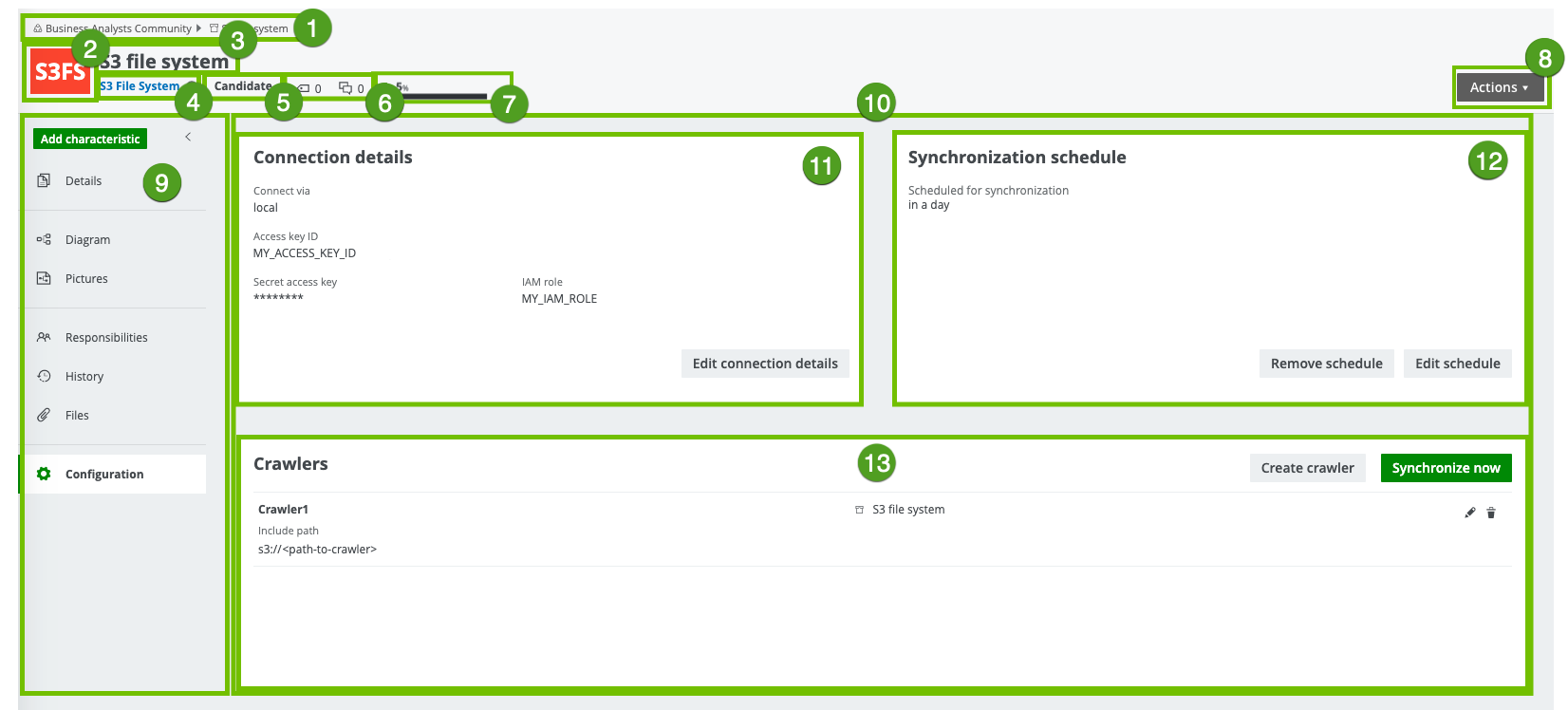
| Number | Section | Description |
|---|---|---|
|
|
Breadcrumbs | The breadcrumbs of the current |
|
|
Asset type representation |
The icon or abbreviation of the Tip You can edit how an asset type is represented. |
|
|
Asset name | The name of the |
|
|
Asset type |
The name of the asset type, for example S3 File System. |
|
|
Status |
The asset status, for example Approved. |
|
|
Collaborative features |
The collaborative features of assets, which consists of the following: |
|
|
Articulation score |
The articulation score of the asset.If there are no articulation score rules assigned to the asset, the asset page does not show an articulation score. |
|
|
Actions menu |
Menu containing specific actions such as starting a workflow. |
|
|
Tab pane |
A collapsible pane that allows you to navigate to other pages of the |
|
|
Editor |
The currently selected page, in this case the Configuration page, which contains the Connection details section, the Synchronization section and Crawlers section of the S3 File System asset. |
|
|
Connection details
|
The connection details to Amazon S3 and a button to edit them. |
|
|
Synchronization
|
A basic explanation about the synchronization schedule and the buttons to add, edit and remove a schedule. |
|
|
Crawlers
|
The list of crawlers of this S3 File System asset and buttons to create a new crawler or manually start synchronizing. |
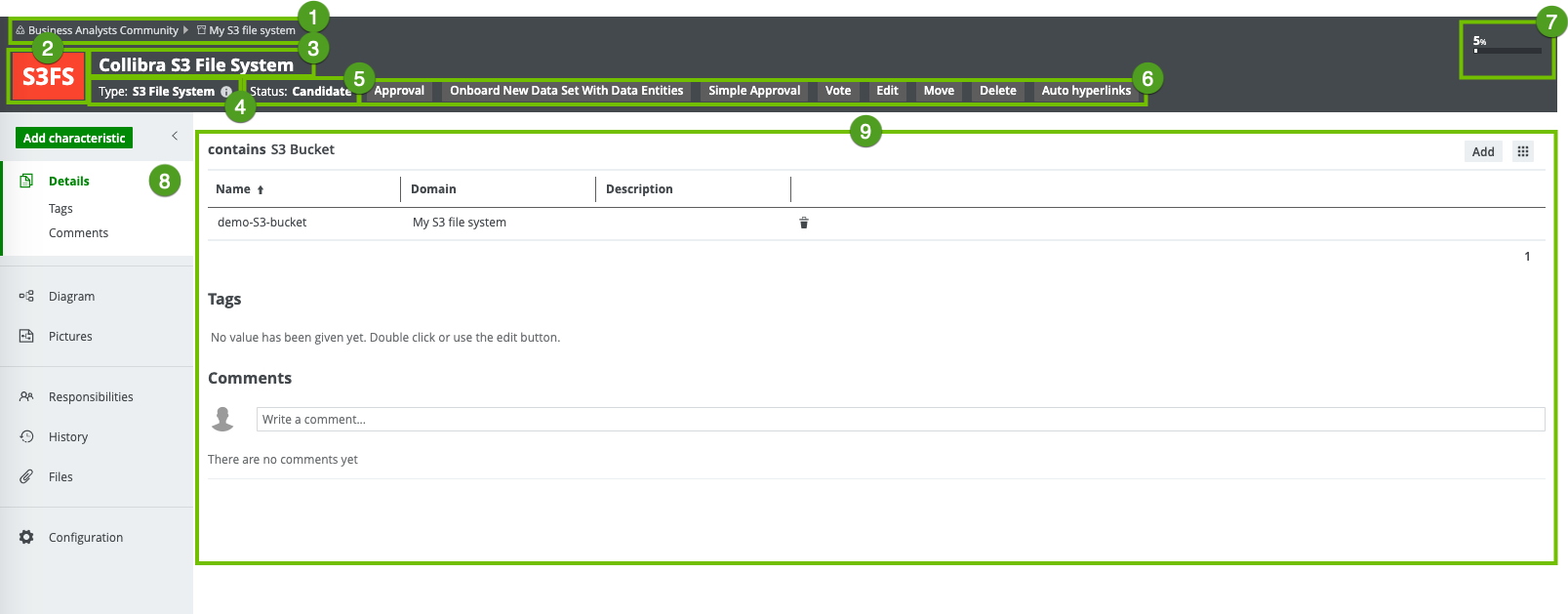
| Number | Section | Description |
|---|---|---|
|
|
Breadcrumbs |
The breadcrumbs of the current |
|
|
Asset type representation |
The icon or abbreviation of the Tip You can edit how an asset type is represented. |
|
|
Asset name |
The name of the |
|
|
Asset type |
The name of the asset type, for example Schema or Data Set. |
|
|
Status |
The asset status, for example Approved. |
|
|
Resource toolbar | Additional actions, such as editing the |
|
|
Articulation score |
The articulation score of the asset.If there are no articulation score rules assigned to the asset, the asset page does not show an articulation score. |
|
|
Tab pane |
A collapsible pane that allows you to navigate to other pages of the |
|
|
Editor |
The currently selected page, in this case the Details tab page, which contains information about the attributes or relations that the user adds to the asset. It also contains tags and comments. |
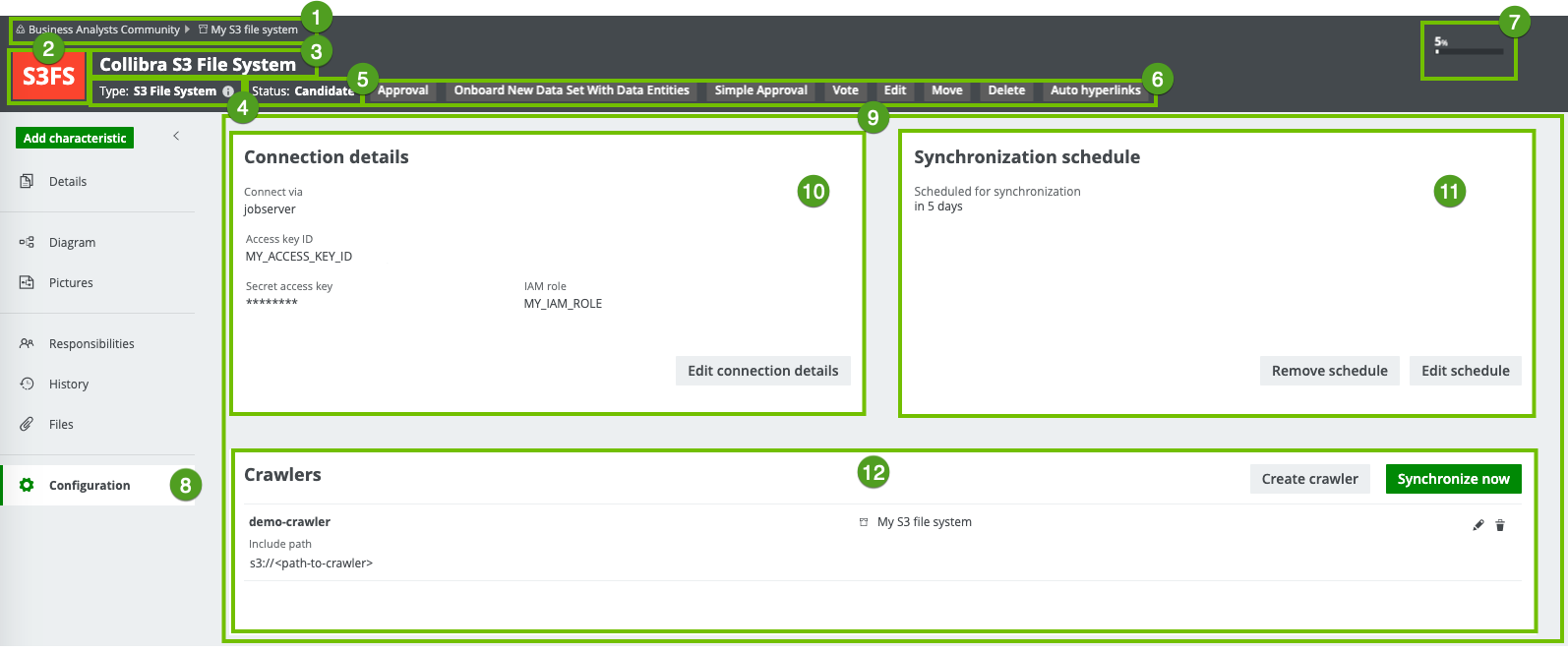
| Number | Section | Description |
|---|---|---|
|
|
Breadcrumbs |
The breadcrumbs of the current |
|
|
Asset type representation |
The icon or abbreviation of the Tip You can edit how an asset type is represented. |
|
|
Asset name |
The name of the |
|
|
Asset type |
The name of the asset type, for example Schema or Data Set. |
|
|
Status |
The asset status, for example Approved. |
|
|
Resource toolbar | Additional actions, such as editing the |
|
|
Articulation score |
The articulation score of the asset. Note If there are no articulation score rules assigned to the asset, the asset page does not show an articulation score. |
|
|
Tab pane |
A collapsible pane that allows you to navigate to other pages of the |
|
|
Editor |
The currently selected page, in this case the Configuration page, which contains the Connection details section, the Synchronization section and Crawlers section of the S3 File System asset. |
|
|
Connection details
|
The connection details to Amazon S3 and a button to edit them. |
|
|
Synchronization
|
A basic explanation about the synchronization schedule and the buttons to add, edit and remove a schedule. |
|
|
Crawlers
|
The list of crawlers of this S3 File System asset and buttons to create a new crawler or manually start synchronizing. |
Warning You only see Power BI asset pages if you have enabled Data Catalog experience.
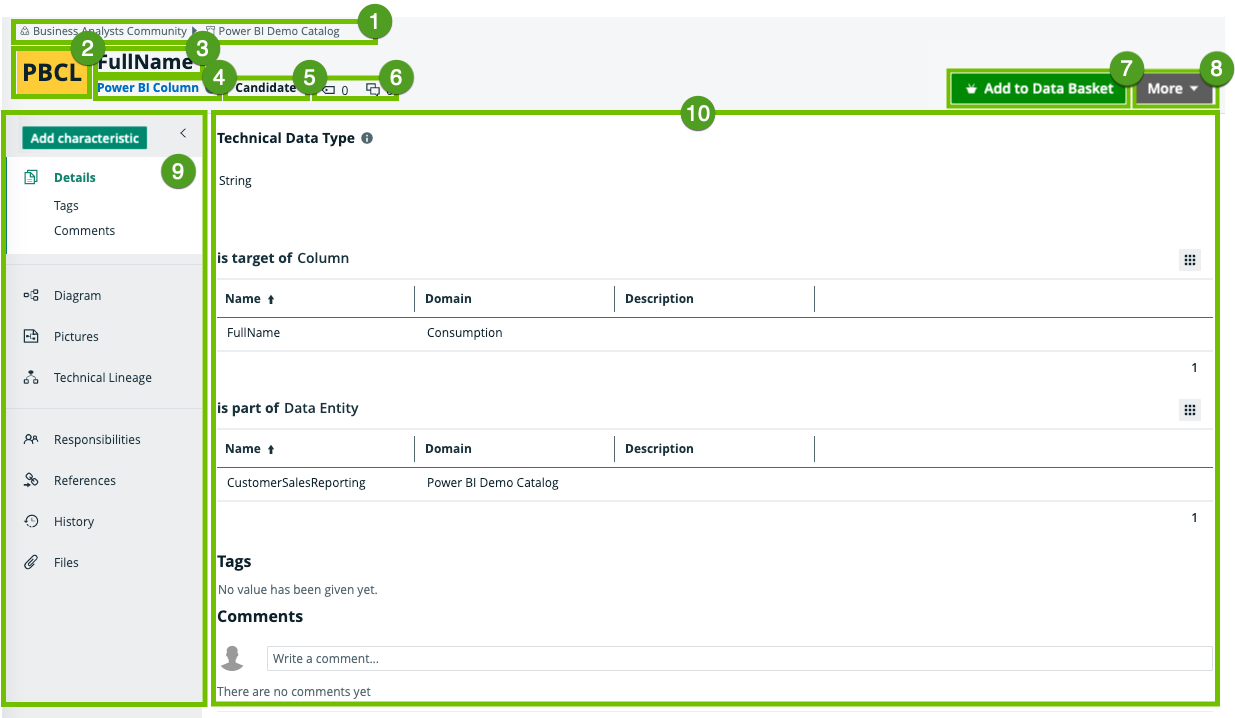
| Number | Section | Description |
|---|---|---|
|
|
Breadcrumbs |
The breadcrumbs of the current |
|
|
Asset type representation |
The icon or abbreviation of the Tip You can edit how an asset type is represented. |
|
|
Asset name |
The name of the |
|
|
Asset type |
The name of the Power BI asset type. |
|
|
Status |
The asset status, for example Approved. |
|
|
Collaborative features |
The collaborative features of assets, which consists of the following: |
|
|
Add to Data Set |
Button to add the asset to a data set. |
|
|
More menu |
Button to start workflows and perform other actions. |
|
|
Tab pane |
A collapsible pane that allows you to navigate to other pages of the Note You only see the Technical lineage tab if you have ingested Power BI metadata (cloud-only feature) and you have the Data Catalog and Technical lineage global permission. |
|
|
Editor |
The currently selected page of the tab pane. Tip If you want to copy and paste text from other sources into a text field, we recommend that you click |
Warning You only see Looker asset pages if you have enabled Data Catalog experience.
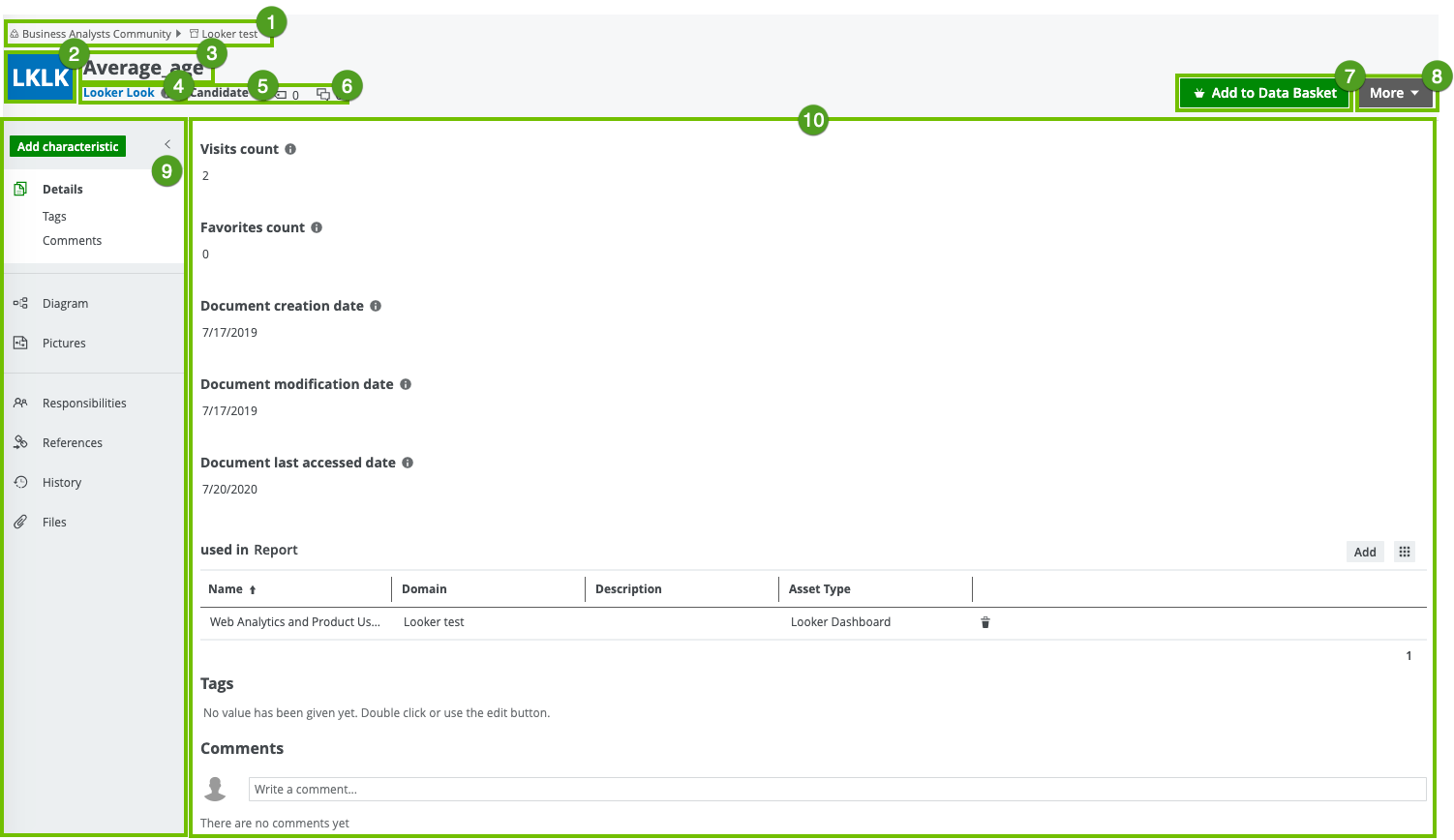
| Number | Section | Description |
|---|---|---|
|
|
Breadcrumbs |
The breadcrumbs of the current |
|
|
Asset type representation |
The icon or abbreviation of the Tip You can edit how an asset type is represented. |
|
|
Asset name |
The name of the |
|
|
Asset type |
The name of the Looker asset type. Tip Make sure to understand the Looker terminology and how it maps with Data Catalog asset types. |
|
|
Status |
The asset status, for example Approved. |
|
|
Collaborative features |
The collaborative features of assets, which consists of the following: |
|
|
Add to Data Set |
Button to add the asset to a data set. |
|
|
More menu |
Button to start workflows and perform other actions. |
|
|
Tab pane |
A collapsible pane that allows you to navigate to other pages of the Note You only see the Technical lineage tab if you have ingested Looker metadata (cloud-only feature) and you have the Data Catalog and Technical lineage global permission. |
|
|
Editor |
The currently selected page of the tab pane. Tip If you want to copy and paste text from other sources into a text field, we recommend that you click |