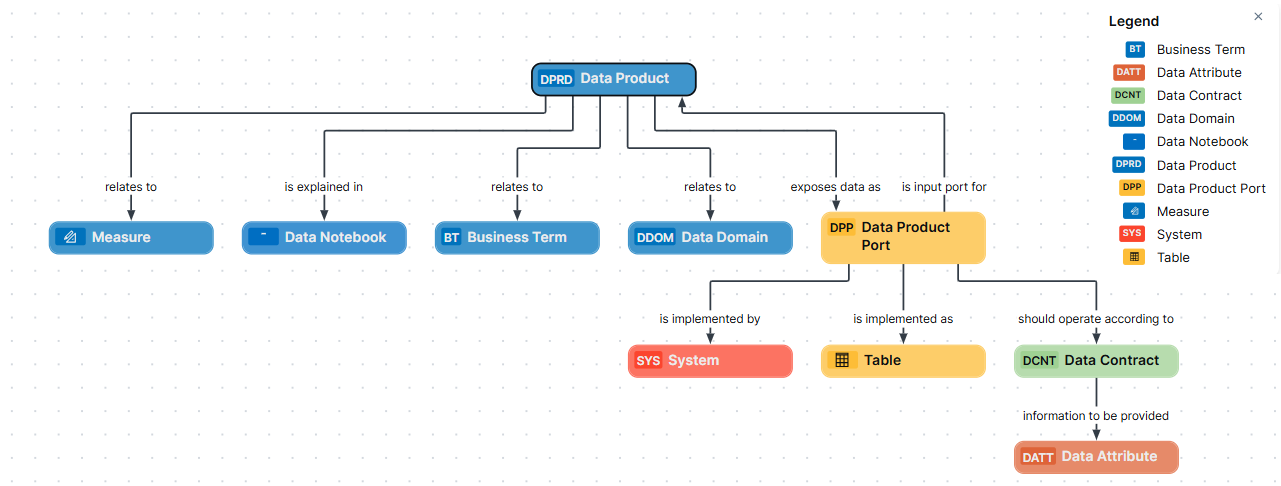
The data product operating model defines the out-of-the-box domain types, asset types, relation types, and attribute types that support your data products.
Domain types
The Data Product Catalog domain type can host Data Product assets and their related assets, such as Data Product Port assets and Data Contract assets.
Asset types
The following asset types are specific to data products.
| Asset type | Description |
|---|---|
| Data Product |
A reusable package that provides data to answer a business question or solve a business problem. The Data Product asset type includes default attribute types and relation types, and a specific asset type layout. |
| Data Product Port |
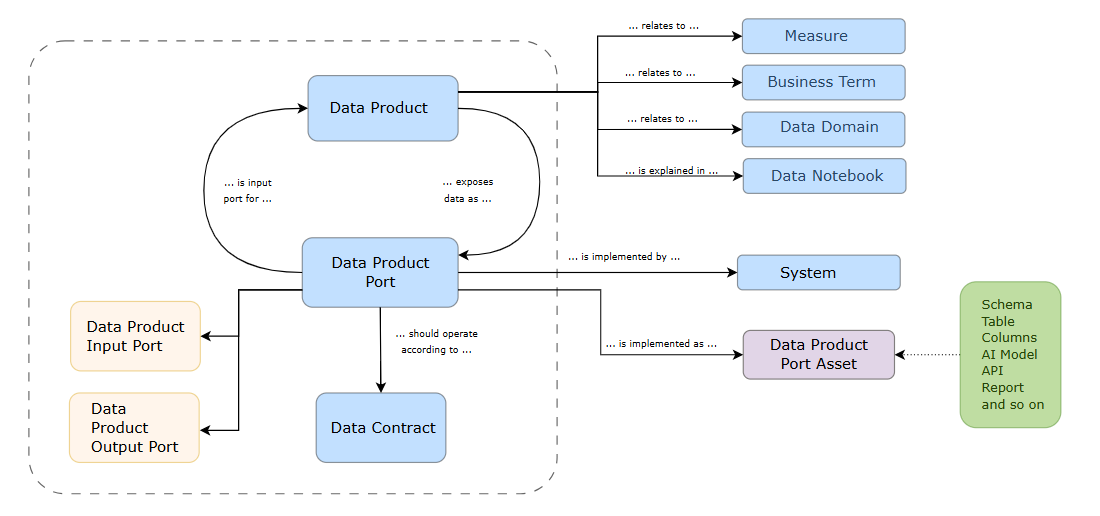
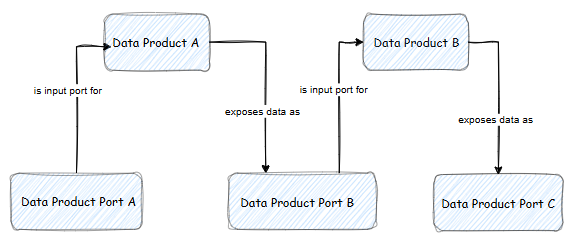
An interface through which a data product interacts with the broader ecosystem. A link between a Data Product Port asset and a Data Product asset through the "exposes data as" relation type is considered an output port and a link through the "consumes data through" relation is considered an input port.
For advanced governance use cases, you can use the Data Product Output Port and Data Product Input Port asset subtypes and their relation types. |
| Data Contract |
A formal commitment that the data product owner makes to data consumers regarding the structure, format, service level, and quality of data. |
Asset type groups
The following asset type groups are specific to data products.
| Asset type group | Description |
|---|---|
| Data Product Port Asset |
Groups assets that are linked to data product ports. By default, only Table assets are included in this group, and we recommend exposing only tables. However, Data Set and Data Element assets are also fully supported in the community workflows if you include them in this asset type group. |
| Data Product Input |
The physical input for a data product. Use this asset type group only for advanced governance use cases that involve the Data Product Input Port asset type. |
Relation types
The following relation types are specific to data products.
- Data Product exposes data as/is output port for Data Product Port
- Data Product Port is input port for/consumes data through Data Product
- Data Product Port is implemented as/implements Data Product Port AssetNote When you create a diagram, you can add this relation type from the Data Product Port asset type to each asset type that is assigned to the Data Product Port Asset asset type group.
- Data Product Input implements/is implemented as Data Product Input PortNote Although this relation type is still available, we recommend using "Data Product Port is implemented as/implements Data Product Port Asset" instead.
- Data Contract governs functioning of/should operate according to Data Product Port
- Data Contract information to be provided/is mentioned in the terms of Data Attribute
- Data Product Port is implemented by/implements System
- Data Product relates to/is related to Measure
- Data Product relates to/is related to Business Term
- Data Product relates to/is related to Data Domain
- Data Product is explained in/explains Data Notebook
Attribute types
The following attribute types are specific to data products.
| Attribute type | Description |
|---|---|
| For the Data Product asset type | |
| Data product category | Defines whether a data product targets business users or technical users. The default values are Derived (for business users) and Foundational (for technical users). |
|
For the Data Product Port asset type |
|
| Access method |
The method that can be used to access data. You can use this attribute type in workflows to create data product ports per access method, in which case, the values must reflect the Collibra asset types. |
| Access instructions |
Instructions about how to access data. |
| For the Data Contract asset type | |
| Version | A label or identifier that represents a specific state or iteration. It is used to track changes over time. |
| Manifest ID | A unique identifier of a manifest file. |
| Backup Frequency |
A backup service level objective that documents the expectations for how often the data is backed up. For systems with point-in-time recovery (PITR), this can be the frequency at which the system creates a new base backup or differential backup. |
| Latency |
A latency service level objective that documents the expectations for the maximum time between the source data becoming available and the data processing completion to make the data available. |
| Most Recent Record Date |
A freshness service level objective that documents the expectations for the maximum age of the most recent entry in the data set. This metric is typically used for static or infrequently updated data sets. |
| Processing Frequency |
A frequency service level objective that documents the expectations for how often the source data is processed to make the latest data set available. |
| Processing Method |
A frequency service level objective that documents the expectations for how the source data is processed. Sample values include batch-processing, streaming, and manual refresh. |
| Recency |
A freshness service level objective that documents the expectations for the maximum age of the most recent entry in the data set. This metric is typically used for result sets that dynamically evolve over time. |
| Recovery Point |
A backup service level objective that documents the expectations for the period of potential data loss in case of a restore. For systems with PITR, the recovery points can be more granular than the backup frequency. |
| Recovery Time |
A backup service level objective that documents the expectations for the maximum time between initiating a restore and completing the backup restoration. |
| Response Time |
A support service level objective that documents the expectations for the maximum time between starting a support request and getting a first response. |
| Retention Period |
A retention service level objective that documents the expectations for how long the records in the data set can be retained. |
| Unlimited Retention |
A retention service level objective that indicates whether a limit is defined for how long the data is retained. If a concrete value is provided for the Retention Period attribute type, this value for this attribute type is expected to be false. |
| Support Availability |
A support service level objective that documents the expectations for the days, times, and periods when technical support is available. |
| Uptime Percentage |
An availability service level objective that documents the expectations for the uptime of the system where the data can be accessed. |
Diagram view