Collibra collects and processes ThoughtSpot metadata to create ThoughtSpot assets and relations in Data Catalog. You can view these assets on their respective asset pages or visualize their structure in a diagram.
After synchronization completes, all retrieved metadata from your ThoughtSpot tenant is available as assets in Collibra Platform. These assets are automatically organized under the domain specified during configuration.
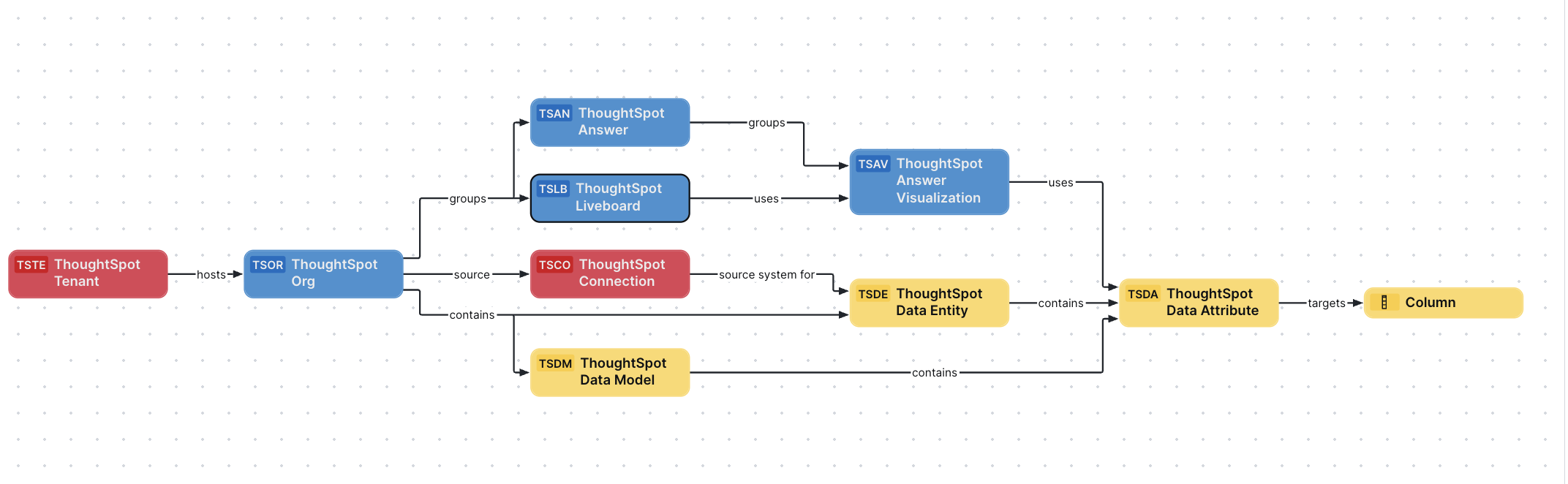
Each synchronized ThoughtSpot object, such as a Tenant, Org, Liveboard, Answer, Data Model, Data Entity, Data Attribute, or Connection, appears as a distinct asset in Data Catalog. The relations between these assets reflect the ThoughtSpot operating model hierarchy.
ThoughtSpot operating model
The following image shows the relations between ThoughtSpot asset types.
Integrated metadata per asset type
When assets are created in Collibra, they are automatically assigned the Candidate status by default. You can update the status according to your workflow.
For BI-related assets, use the Implemented status after the metadata are validated and approved for governance.
This table lists the integrated metadata for each ThoughtSpot asset type.
|
Asset type |
Synchronized metadata |
Public ID |
|---|---|---|
|
ThoughtSpot Tenant Public ID: ThoughtSpotTenant |
Full name |
|
| Display name | ||
| Server hosts / is hosted in Business Dimension | ServerHostsBusinessDimension | |
|
ThoughtSpot Org Public ID: ThoughtSpotOrg |
Full name |
|
| Display name | ||
| Description | Description | |
| Server hosts / is hosted in Business Dimension | ServerHostsBusinessDimension | |
| Business Dimension source / is source of System | BusinessDimensionSourceSystem | |
| Business Dimension groups / is grouped into Report | BusinessDimensionGroupsReport | |
|
BI Folder contains / contained in Data Asset |
BIFolderContainsDataAsset | |
|
ThoughtSpot Liveboard Public ID: ThoughtSpotLiveboard |
Full name |
|
| Display name | ||
|
URL |
Url | |
|
Report uses / used in Report |
ReportUsesReport | |
| Business Dimension groups / is grouped into Report | BusinessDimensionGroupsReport | |
|
ThoughtSpot Answer Public ID: ThoughtSpotAnswer
|
Full name |
|
|
Display name |
||
|
Description |
Description | |
| Owner in Source | OwnerInSource | |
|
Business Dimension groups / is grouped into Report |
BusinessDimensionGroupsReport | |
|
Report groups / is grouped into Report |
ReportGroupsReport | |
|
ThoughtSpot Data Model Public ID: ThoughtSpotDataModel |
Full name |
|
|
Display name |
||
|
BI Folder contains / contained in Data Asset |
BIFolderContainsDataAsset | |
|
BI Data Model contains / is part of BI Data Attribute |
BIDataModelContainsBIDataAttribute | |
|
ThoughtSpot Data Entity Public ID: ThoughtSpotDataEntity |
Full name |
|
| Display name | ||
| Description | Description | |
| Technology Asset source system for / source system Data Asset | TechnologyAssetSourceSystemForDataAsset | |
|
BI Folder contains / contained in Data Asset |
BIFolderContainsDataAsset | |
|
Data Entity is part of / contains Data Attribute |
DataEntityContainsDataAttribute | |
|
ThoughtSpot Data Attribute Public ID: ThoughtSpotDataAttribute |
Full name | |
| Display name | ||
| Description | Description | |
|
Data Entity is part of / contains Data Attribute |
DataEntityContainsDataAttribute | |
|
BI Data Model contains / is part of BI Data Attribute |
BIDataModelContainsBIDataAttribute | |
| Data Attribute represents / represented by Column | DataAttributeRepresentsColumn | |
|
ThoughtSpot Connection Public ID: ThoughtSpotConnection |
Full name |
|
|
Display name |
||
|
Description |
Description | |
| Business Dimension source / is source of System | BusinessDimensionSourceSystem | |
| Technology Asset source system for / source system Data Asset | TechnologyAssetSourceSystemForDataAsset | |
|
ThoughtSpot Answer Visualization Public ID: ThoughtSpotAnswerVisualization |
Full name |
|
| Display name | ||
|
Report uses / used in Report |
ReportUsesReport | |
|
Report groups / is grouped into Report |
ReportGroupsReport | |
|
Report uses / used in Data Attribute |
ReportUsesDataAttribute | |
|
Column Public ID: Column |
Full name |
|
|
Display name |
||
| Description | Description | |
| Data Attribute represents / represented by Column | DataAttributeRepresentsColumn |
Note The metadata that is shown on the assets' pages depends on the asset type's assignment. As a result, you might not see all harvested metadata on the asset's page by default.
Recommended hierarchy within a domain
You can enable hierarchies for the domain (or domains) in which your ThoughtSpot assets are integrated. Doing so makes it easier to understand the relation between your ThoughtSpot assets, when viewing the assets on the domain page.
Follow these steps to enable and configure the recommended hierarchy.
Steps
- Open the domain page of the relevant BI Catalog domain.
- On the content toolbar, click
 .
.
The Configure Hierarchy dialog box appears. - Select Enable Hierarchy.
- Select Multipath.
- Start typing and select each of the following relation types:
- Server hosts Business Dimension
- Business Dimension source System
- Business Dimension groups Report
- BI Folder contains Data Asset
- Report groups Report
- BI Data Model contains BI Data Attribute
- Technology Asset source system for Data Asset
- BI Report source Data Asset
- Data Model contains Data Entity
- BI Data Model contains BI Data Attribute
- Data Entity contains Data Attribute
- Data Attribute represents Column
- Click Apply.
- In an asset view, if any asset is deleted, for example via synchronization or manual deletion, the view is recreated and the hierarchy is lost. In this case, you can again enable and configure the recommended hierarchy.
- When viewing the hierarchy for a community or domain, if the parent of a node that is in the community or domain belongs to a different community or domain, that node is not shown in the hierarchy.
Create a ThoughtSpot operating model diagram view
You can create a ThoughtSpot specific diagram view, to visualize the operating model. The following procedure provides instruction on how to quickly create a new diagram view by copying and pasting the JSON code in the diagram view text editor.
Steps
- Open the asset page.
- Click the
Diagram tab.
The diagram is shown in the default diagram view. - Click
 to add a new view.
 - Select the Text option below the diagram view name.
The diagram view text editor is shown. - Copy the code from the Show JSON code section below and paste it in the diagram view text editor.
- Click Save.
- Edit the name and description of the diagram view as needed.
{
  "nodes": [
    {
      "id": "ThoughtSpot Liveboard",
      "type": {
        "id": "00000000-0000-0000-0000-100000000114"
      }
    },
    {
      "id": "ThoughtSpot Answer Visualization",
      "type": {
        "id": "00000000-0000-0000-0000-100000000116"
      }
    },
    {
      "id": "ThoughtSpot Org",
      "type": {
        "id": "00000000-0000-0000-0000-100000000113"
      }
    },
    {
      "id": "ThoughtSpot Tenant",
      "type": {
        "id": "00000000-0000-0000-0000-100000000111"
      }
    },
    {
      "id": "ThoughtSpot Answer",
      "type": {
        "id": "00000000-0000-0000-0000-100000000115"
      }
    },
    {
      "id": "ThoughtSpot Data Attribute",
      "type": {
        "id": "00000000-0000-0000-0000-100000000119"
      }
    },
    {
      "id": "ThoughtSpot Connection",
      "type": {
        "id": "00000000-0000-0000-0000-100000000112"
      }
    },
    {
      "id": "ThoughtSpot Data Entity",
      "type": {
        "id": "00000000-0000-0000-0000-100000000118"
      }
    },
    {
      "id": "ThoughtSpot Data Model",
      "type": {
        "id": "00000000-0000-0000-0000-100000000117"
      }
    },
    {
      "id": "Column",
      "type": {
        "id": "00000000-0000-0000-0000-000000031008"
      }
    }
  ],
  "edges": [
    {
      "from": "ThoughtSpot Liveboard",
      "to": "ThoughtSpot Answer Visualization",
      "label": "",
      "style": "arrow",
      "type": {
        "id": "00000000-0000-0000-0000-120000000007"
      },
      "roleDirection": true
    },
    {
      "from": "ThoughtSpot Org",
      "to": "ThoughtSpot Liveboard",
      "label": "",
      "style": "arrow",
      "type": {
        "id": "00000000-0000-0000-0000-120000000002"
      },
      "roleDirection": true
    },
    {
      "from": "ThoughtSpot Tenant",
      "to": "ThoughtSpot Org",
      "label": "",
      "style": "arrow",
      "type": {
        "id": "00000000-0000-0000-0000-120000000000"
      },
      "roleDirection": true
    },
    {
      "from": "ThoughtSpot Org",
      "to": "ThoughtSpot Answer",
      "label": "",
      "style": "arrow",
      "type": {
        "id": "00000000-0000-0000-0000-120000000002"
      },
      "roleDirection": true
    },
    {
      "from": "ThoughtSpot Answer",
      "to": "ThoughtSpot Answer Visualization",
      "label": "",
      "style": "arrow",
      "type": {
        "id": "00000000-0000-0000-0000-120000000004"
      },
      "roleDirection": true
    },
    {
      "from": "ThoughtSpot Answer Visualization",
      "to": "ThoughtSpot Data Attribute",
      "label": "",
      "style": "arrow",
      "type": {
        "id": "00000000-0000-0000-0000-120000000021"
      },
      "roleDirection": true
    },
    {
      "from": "ThoughtSpot Org",
      "to": "ThoughtSpot Connection",
      "label": "",
      "style": "arrow",
      "type": {
        "id": "00000000-0000-0000-0000-120000000003"
      },
      "roleDirection": true
    },
    {
      "from": "ThoughtSpot Org",
      "to": "ThoughtSpot Data Entity",
      "label": "",
      "style": "arrow",
      "type": {
        "id": "00000000-0000-0000-0000-120000000014"
      },
      "roleDirection": true
    },
    {
      "from": "ThoughtSpot Org",
      "to": "ThoughtSpot Data Model",
      "label": "",
      "style": "arrow",
      "type": {
        "id": "00000000-0000-0000-0000-120000000014"
      },
      "roleDirection": true
    },
    {
      "from": "ThoughtSpot Data Model",
      "to": "ThoughtSpot Data Attribute",
      "label": "",
      "style": "arrow",
      "type": {
        "id": "00000000-0000-0000-0000-000000007196"
      },
      "roleDirection": true
    },
    {
      "from": "ThoughtSpot Data Attribute",
      "to": "Column",
      "label": "",
      "style": "arrow",
      "type": {
        "id": "00000000-0000-0000-0000-000000007069"
      },
      "roleDirection": true
    },
    {
      "from": "ThoughtSpot Connection",
      "to": "ThoughtSpot Data Entity",
      "label": "",
      "style": "arrow",
      "type": {
        "id": "00000000-0000-0000-0000-000000007050"
      },
      "roleDirection": true
    },
    {
      "from": "ThoughtSpot Data Entity",
      "to": "ThoughtSpot Data Attribute",
      "label": "",
      "style": "arrow",
      "type": {
        "id": "00000000-0000-0000-0000-000000007047"
      },
      "roleDirection": true
    }
  ],
  "showOverview": false,
  "enableFilters": true,
  "showLabels": true,
  "showFields": true,
  "showLegend": true,
  "showPreview": true,
  "visitStrategy": "directed",
  "layout": "HierarchyLeftRight",
  "maxNodeLabelLength": 50,
  "maxEdgeLabelLength": 30,
  "layoutOptions": {
    "compactGroups": false,
    "componentArrangementPolicy": "topmost",
    "edgeBends": true,
    "edgeBundling": true,
    "edgeToEdgeDistance": 5,
    "minimumLayerDistance": "auto",
    "nodeToEdgeDistance": 5,
    "orthogonalRouting": true,
    "preciseNodeHeightCalculation": true,
    "recursiveGroupLayering": true,
    "separateLayers": true,
    "webWorkers": true,
    "nodePlacer": {
      "barycenterMode": true,
      "breakLongSegments": true,
      "groupCompactionStrategy": "none",
      "nodeCompaction": false,
      "straightenEdges": true
    }
  }
}