After the synchronization, the resulting assets are in the domain that was specified in the crawler.
Warning Do not move the assets to another domain. Doing so may lead to errors during future synchronizations.
Tip GCS synchronization relies on UUIDs.
Note In case of a partial synchronization caused by a temporary communication issue, the status of the assets that cannot be synchronized is set to Missing from source. Their previous status is restored, if they are found in the source system during the next fully successful synchronization.
By default, the assets are shown in a plain list, but you can enable a multi-path hierarchy to show it in a tree structure. The resulting assets depend on whether you use Google Dataplex.
Synchronization results without Google Dataplex
For the best result, we recommend that you use the following relations:
- File Storage contains File Container
- File Container contains File Container
- File Container contains File
- Directory contains Directory
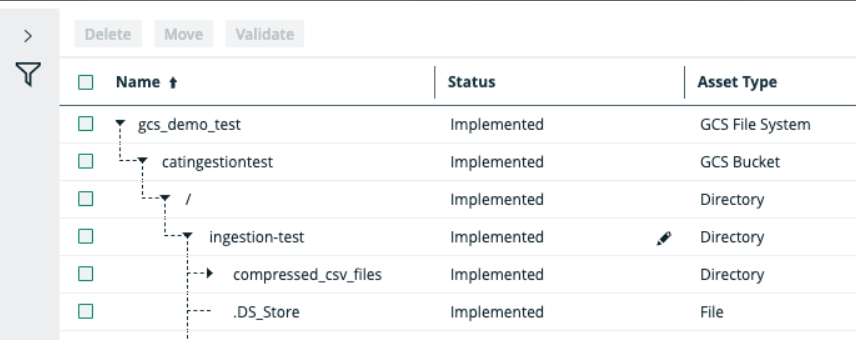
The following images shows the resulting hierarchical table.
Synchronization results with Google Dataplex
For the best result, we recommend that you use the following relations:
- File Storage contains File Container
- File Container contains File Container
- File Container contains File
- Directory contains Directory
- Directory contains File Group
- File Group contains Table
- Table contains Column
The following images shows the resulting hierarchical table.
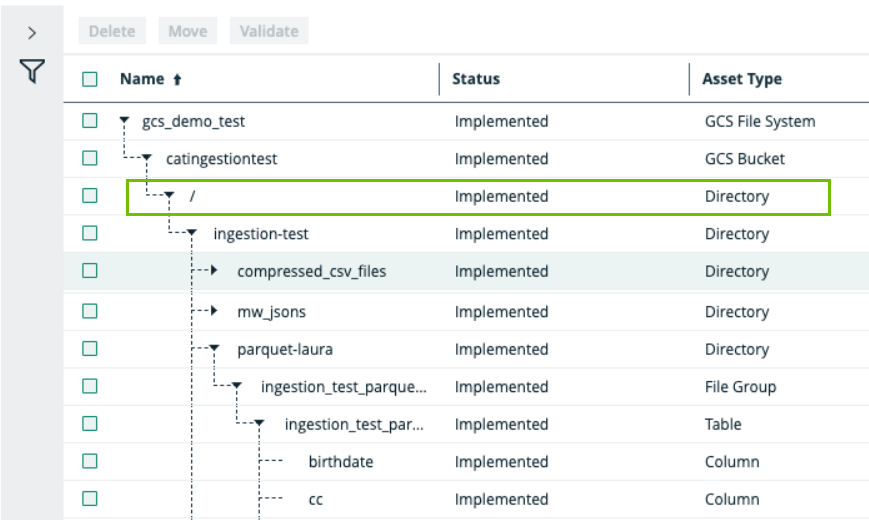
The synchronization creates a Directory asset named /. This is needed to ensure the asset can contain the File Group assets.