Import assets
You can import
- If you want to edit a lot of assets in one go, you can perform the so-called export/import roundtrip. First create a view that contains all the assets and characteristics that you want to edit, then export the assets from that view. You can then edit the exported file, and import the assets back into the same view. Collibra will automatically map the characteristics during the import, implementing your changes.
- Importing assets and complex relations is restricted by the file upload settings, which define the maximum file size, allowed file extensions and maximum amount of uploads and downloads per day.
- When importing a very large Excel file, you may encounter an error with the file being too large. If this is the case you will need to split the file into multiple smaller files or use CSV.
- Importing data from a large Excel file can consume a lot of memory. We advise you to import from CSV instead of Excel, or to limit the Excel file to only contain the data you really need.
Prerequisites
- You have prepared an Excel
- Only the essential sheets, columns and rows remain.
- Numbers that have to be interpreted as text are preceded by a single quotation mark.
- Dates are formatted as yyyy-mm-dd.
- If you want to import responsibilities, Asset responsibilities support is enabled.
- Import using the new wizard
- Import using the old wizard
Import using the new wizard
Tip You can import responsibilities along with your assets.
- Open a view.
- Above the table, to the right, click
 →
→
The Import dialog box appears. - Drag and drop the file or click Upload a file and choose the appropriate Excel
- If you chose a CSV file:
- Enter the required information.
Field Description Column Separator The character used to delimit the columns in the CSV file. Quote The character before and after a string to capture the entire cell. Escape Character The character that is used to use the column separator or quote character as plain text.
- Enter the required information.
- Click Next.
- Manage the mapping of the fields of the import file and your Collibra resources:
- The Import mapping dialog box appears and Collibra tries to map the table headers in your import file to Collibra resources, based on the names of the fields and columns.Learn more about the mapping dialog box.
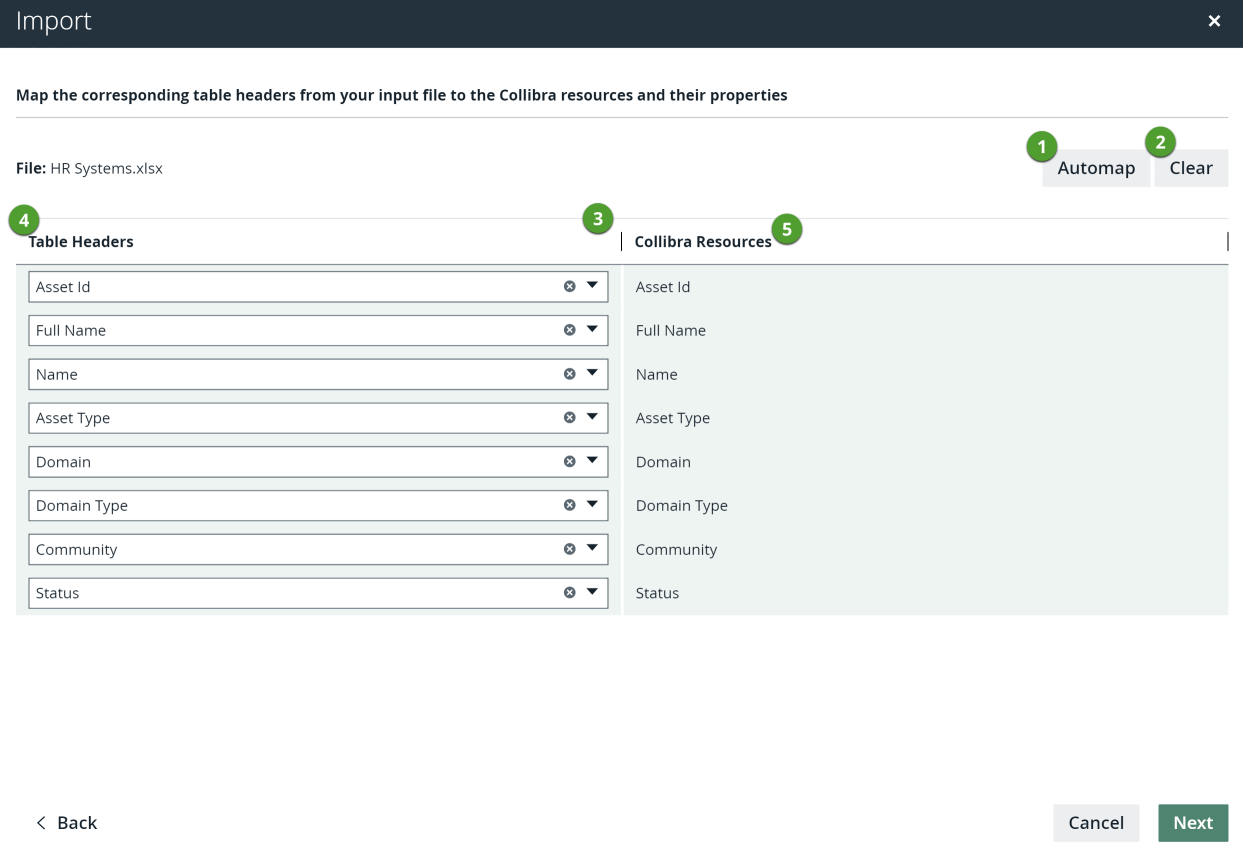
Number Field Description 1
Automap
Button to let Collibra automatically map all table headers in the import file to Collibra resources, based on their names.
2
Clear
Button to remove all mappings.
3
Mapping table
This table enables you to map table headers in the import file to Collibra resources.
Each row in the table has a background color to indicate whether the table header is mapped or not.
- Green: When the table header from the import file is mapped to a Collibra resource the row will be highlighted in green.
- Red: After clicking the warning about unmapped items these rows will be highlighted in red and moved to a separate section at the bottom of the table.
Once a table header in the unmapped section has a mapping selected it will be moved to the green mapped section.
You can use the Automap button to automatically map a table header, unless you have already manually changed the mapping. If you manually change a mapping then auto-mapping will not longer override this selection.
An individual mapping can be cleared by using the cross icon in the Table Headers column.
If a relation type in your file matches with multiple relation types in Collibra then it will not be auto-mapped, meaning you will be required to map this relation type manually. This is to avoid any incorrect mapping.
4
Table Headers This column contains the field name of the table headers in your file. 5
Collibra Resources This column shows to which Collibra resource the file field is mapped. If the field is unmapped then there is a drop down list with the available Collibraresources . For relations, a hierarchy is displayed.
- Click Automap to let Collibra map all previously unmapped columns automatically.
- If required, manually map columns to another resource.
- Click Next.
The Import options appear.
- The Import mapping dialog box appears and Collibra tries to map the table headers in your import file to Collibra resources, based on the names of the fields and columns.
- Enter the required information.
Setting Result Create new assets if they don't yet exist If assets do not exist, Collibra creates them.
Collibra creates a new domain and top-level community if the following conditions are met:
- You mapped columns of the import file to the domain, domain type and community characteristics of the view.
- The columns contain a domain and/ or community name that doesn't exist yet.
How do you want to handle existing assets? Choose to either:
- Delete existing assets and recreate them again based on the file.
- Update existing assets with any new values from the file.
How do you want to handle existing attributes, relations and responsibilities that were mapped? Choose to either:
- Replace all existing values with the ones provided in the file.
- Only add new values.
Delete existing assets from the domain that are not in the file. Collibra deletes existing assets from a domain if they are not in the import file. If an existing domain is referenced in the import file, then any assets from that domain not included in the file are also deleted. This applies to all domains defined for relations as well. Test import Collibra first simulates an import without affecting the data to give you an overview of how the actual import would affect the data. After the overview, you can proceed with the import, go back to change the options or cancel the import. - Click the Test Import button.
The test results appear. - If everything looks okay, click Import.
If it doesn't, click Back to change the mapping or import options.
The import results appear. - Click Close.
Import using the old wizard
Note For the original import wizard, the max file size is restricted to 100 MB.
- Open a view.
- Above the table, to the right, click →
The Import dialog box appears. - Click Select File and choose the appropriate Excel
- Click Next.
- If you chose a CSV file, do the following:
- Enter the required information.
Field Description Column Separator The character used to delimit the columns in the CSV file. Quote The character before and after a string to capture the entire cell. Escape Character The character that is used to use the column separator or quote character as plain text. - Click Next.
- Enter the required information.
- Manage the mapping of the columns of the import file and the view's fields.
- The Import mapping dialog box appears and Collibra tries to map the columns from the import file with the Collibra resources, based on the names of the columns and resources.Learn more about the mapping dialog box.
Visual
Number Field Description 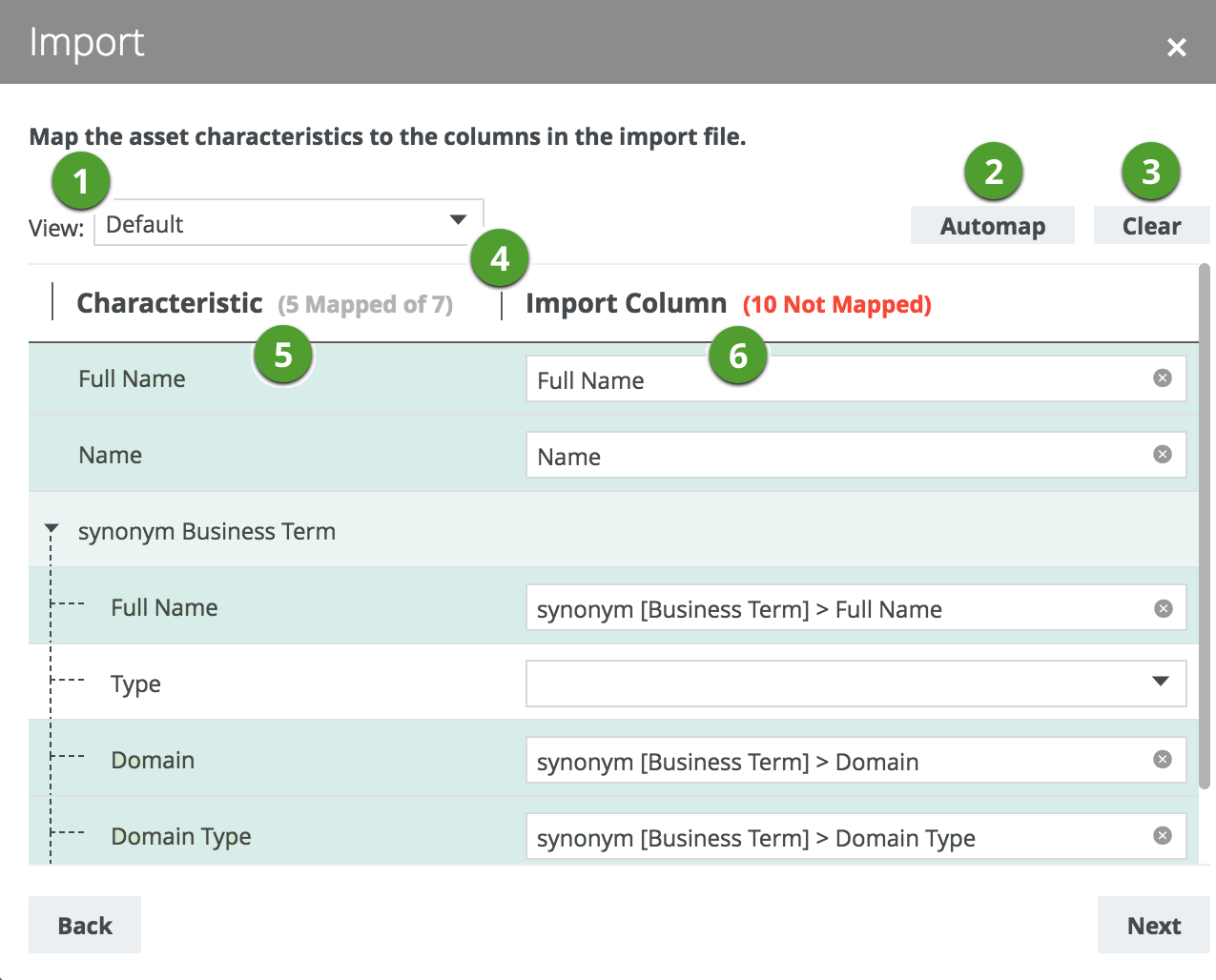
1
View selector
The view selector allows you to choose a view whose characteristics will appear in the list.
Tip You can also choose All characteristics to show all characteristics.
2
Automap
Button to let Collibra automatically map all fields of the view to the columns in the import file, based on the names of the characteristics and columns.
3
Clear
Button to clear all mapped characteristics in the Import Column.
4
Mapping table
This table enables you to map characteristics of the view to columns of the import file.
Each row has a background color to indicate whether a characteristics is mapped or not.
- Dark green: The characteristic is mapped to a column in the import file.
- Light green: The relation is mapped partially. This means not all underlying fields are mapped.
- White: The characteristic is not mapped.
5
CharacteristicThis column contains the available characteristics. Depending on the selection in the view selector, it contains either the characteristics of the selected view, or all characteristics. For relations, a hierarchy is displayed. 6
Import ColumnThis column should contain fields in which you can choose columns of the import file to map to a characteristic of the view.
- If required, choose another view in the view selector. Tip Choose All characteristics to show all characteristics. In most cases, this makes it easier to map all characteristics.
- Click Automap to let Collibra map all visible columns automatically.
- If required, manually map columns to another characteristic.
- The Import mapping dialog box appears and Collibra tries to map the columns from the import file with the Collibra resources, based on the names of the columns and resources.
- Click Next.
The Import options appear. - Enter the required information.
Setting Result Create new assets and domains if non-existent. If assets or domains do not exist, Collibra creates them.
Collibra creates a new domain and top-level community if the following conditions are met:
- You mapped columns of the import file to the domain, domain type and community characteristics of the view.
- The columns contain a domain and/or community name that doesn't exist yet.
How do you want to handle existing assets? Replace them with the new assets. (=> delete + create)If assets exist, Collibra deletes them first and creates them again based on the import file. Update the name, properties and attributes.If assets exist, Collibra compares the attributes and updates them if necessary. How do you want to handle mapped attributes? Replace them with new attributes. (=> delete + create)If attributes exist, Collibra deletes them and creates them again based on the import file.
Select this option if you want to update existing, or add new attributes, such as a definition.
Create as new attributes.If attributes exist, Collibra creates another instance of the attributes based on the import file.
Select this option if you do not want to edit the existing attributes, but always want to create new attributes. This could result in multiple instances of the same attributes, such as a definition.
Delete existing assets from the domain that are not in the file. Collibra deletes existing assets from a domain if they are not in the import file. If an existing domain is referenced in the import file, then any assets from that domain not included in the file are also deleted. This applies to all domains defined for relations as well. Test Import Collibra first simulates an import without affecting the data to give you an overview of how the actual import would affect the data. After the overview, you can proceed with the import, go back to change the options or cancel the import. - Click the Test Import button.
The test results appear. - If everything looks okay, click Import.
If it doesn't, close the dialog box to cancel the import or click Back to change the mapping or import options.
The import results appear. - Click Close.